How to Choose a Hostel Without Getting Burned
Last updated: 28 September 2026. Figures checked against the sources listed at the end of this article.
What if the cheapest bed on the page is the one that costs you most? It happens constantly, and it is almost never visible in the listing.
A hostel three dollars cheaper per night, six kilometres out from the centre, reads as a saving — right up until you count the trips you make into town and back. At that point the arithmetic flips.
Choosing a hostel is not a hunt for the lowest number. It is the act of reading four signals that genuinely predict whether you will sleep, while ignoring the ones that merely look like signals.
The gap between those two things is a night’s sleep, a bag that is still there in the morning, and about thirty seconds of arithmetic.
The four signals that predict a good stay
Ignore the photographs. Every hostel photographs its best corner, and the best corner is not where you sleep.
1. Where it sits relative to how you will actually move. Not “how far from the centre” in the abstract, but how far from the transport you will use, at the hours you will use it. A hostel 300 metres from a metro stop beats one 800 metres from the beach if you are going to spend your days in the city.
2. Whether the room can be made cold at night. In hot, humid climates this decides your entire trip. Air conditioning that runs only between certain hours, or a fan-only dorm in a 35°C city, is the difference between sleeping and lying awake. This is one of the few things worth paying more for.
3. The bed count in the dorm. A six-bed dorm and a sixteen-bed dorm are different products at similar prices. Fewer beds means less noise, fewer alarms at 5am, fewer people climbing to a top bunk above you.
4. Whether lockers exist and actually lock. Not “lockers available” — lockers with a working lock, or a padlock point you can use with your own. This is a security question, not a convenience one.
Notice what is not on the list: the bar, the pool, the “vibrant social atmosphere”. Those are real reasons to pick one place over another, but none of them predict whether you sleep or whether your bag is safe.
One booking decision, taken apart
Illustrative example: the two bed prices below are assumed, not researched. They exist to show the arithmetic. The transport price is real, and comes from Numbeo’s Bangkok city data for September 2026. Swap in your own two listings and the method works exactly the same way.
The setup. Two beds in Bangkok. Hostel A costs $12 a night and sits six kilometres from the old town. Hostel B costs $15 a night and sits 400 metres from it. A is $3 cheaper. On a five-night stay, A saves you $15.
The cost A does not show you. Numbeo’s Bangkok data, current as of September 2026, puts a one-way local transport ticket at ฿36.50, or roughly $1.09 at the exchange rate of 27 September 2026. Suppose you go into town and back twice a day — four one-way trips, a normal pattern if you are sightseeing and eating out.
That is $4.37 a day in transport for Hostel A, against nothing for Hostel B.
| Hostel A (6 km out) | Hostel B (400 m out) | |
|---|---|---|
| Bed, per night | $12.00 | $15.00 |
| Local transport, 4 trips/day | $4.37 | $0.00 |
| Effective daily cost | $16.37 | $15.00 |
| Five nights | $81.85 | $75.00 |
Hostel A costs more. The “$3 cheaper” bed is $1.37 a day more expensive, and it also costs you the time spent travelling and the evening you cut short because getting back is a hassle.
The same decision flips in a different city
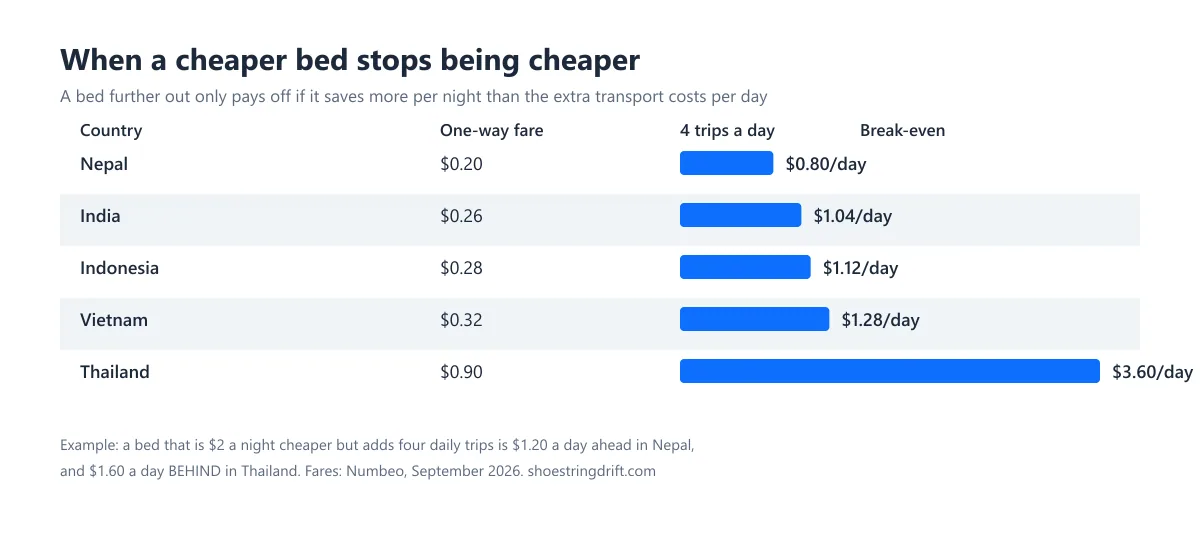
This is the part that matters, because the advice “always stay central” is wrong. The answer depends on local transport prices, and they vary enormously across the region — and, as the table shows, within countries too.
| City | One-way local fare | 4 trips per day | The cheaper bed wins only if it saves more than |
|---|---|---|---|
| Kathmandu | $0.20 | $0.80 | $0.80 per day |
| Denpasar | $0.25 | $1.00 | $1.00 per day |
| Ho Chi Minh City | $0.27 | $1.08 | $1.08 per day |
| Jakarta | $0.28 | $1.12 | $1.12 per day |
| Hanoi | $0.39 | $1.56 | $1.56 per day |
| Delhi | $0.42 | $1.68 | $1.68 per day |
| Phnom Penh | $0.45 | $1.80 | $1.80 per day |
| Bangkok | $1.09 | $4.37 | $4.37 per day |
Fares: Numbeo city data, September 2026. Converted at rates dated 27 September 2026 (exchangerate-api.com).
Read the last column as your break-even point. In Kathmandu, a bed that is $2 cheaper but adds four daily trips is still worth taking — you are $1.20 a day ahead. In Bangkok, that same bed needs to save you more than $4.37 a day before it makes sense, and beds rarely differ by that much.
Note the range behind Bangkok’s figure: Numbeo reports ฿25 to ฿61 for the same ticket, so the break-even there is somewhere between $3.00 and $7.32 a day depending on how you travel. That spread is wider than the gap between the cheapest and dearest cities on the list, which is why the sum is worth doing with your own numbers rather than a published average.
So the rule is not “stay central” and it is not “always take the cheaper bed”. It is: do the break-even sum for the city you are in. It takes thirty seconds and it is the single highest-value calculation in budget travel.
What reviews can and cannot tell you
Reviews are useful, badly used, and easy to misread.
What they are good for: recurring complaints. One person saying the showers were cold is noise. Six separate reviews across six months mentioning cold showers is a pattern, and patterns are what you are looking for. Read the three-star reviews first — the five-star ones are usually written on the way out of a good mood, and the one-star ones are written by people who had an unusual day.
What they cannot tell you: how the place will be during your dates. A hostel that was quiet in low season can be a party hostel in high season, because the crowd changes and the building does not. Reviews are a record of the past, not a forecast.
What to ignore entirely: the score. An 8.4 and an 8.7 are the same hostel on a different week. The gap between them is statistical noise, not a quality difference, and paying extra for 0.3 of a point is paying for nothing.
The two-minute routine before you pay
- Open a map and measure the walk from the hostel to the transport you will actually use. Not to the city centre — to the stop, station or pier.
- Count the beds in the dorm you are booking. If the listing does not say, assume worse than the photos suggest.
- Check how the room is cooled and whether it runs all night. If it is unclear, assume it does not.
- Read the three-star reviews only, looking for the same complaint repeated.
- Run the break-even sum with the transport price from the table above.
- Book two nights, not seven. You can always extend from inside the building; you cannot easily escape a week you have already paid for.
- Numbeo, Cost of Living country data for Thailand, Nepal, India, Indonesia and Vietnam, September 2026 — https://www.numbeo.com/cost-of-living/
- exchangerate-api.com, exchange rates dated 27 September 2026 — https://www.exchangerate-api.com
- UK Foreign, Commonwealth & Development Office, Foreign travel advice — https://www.gov.uk/foreign-travel-advice
- Government of Canada, Travel advisories — https://travel.gc.ca/travelling/advisories
That last point is the one people resist and the one that saves the most money. A two-night booking costs slightly more per night and buys you the option to leave.
When the cheap option is genuinely right
None of the above means the out-of-town bed is a mistake. It is often the correct choice, for three specific reasons.
You are staying long. Over a month, the break-even sum changes completely, because you will not make four trips a day every day. If you are working, resting or writing, you might make one.
You want quiet. Central hostels in the middle of a backpacker district are loud, and a quiet bed six kilometres out can be worth far more than the transport it costs.
You have a bike or scooter. This breaks the calculation entirely, because the cost structure is different. Check your own government’s advice and your insurance before riding anywhere unfamiliar — the UK FCDO travel advice and Government of Canada advisories both cover local transport risk by country.
Conclusion
The cheapest bed is a number, not a decision. Work out the break-even sum for the city you are in — in Bangkok you need a saving of more than $4.37 a day before an out-of-town bed pays off, and in Kathmandu more than $0.80 — then book two nights and decide the rest from inside the building.
Run that sum against the country costs in our guide to the cheapest countries to travel on a budget, and put the result into your overall figures using our method for working out what a backpacking trip costs. Accommodation is the largest single line in a backpacking budget, and it is the one where a thirty-second calculation changes the answer.
Then get the other half of the equation right. A hostel with working lockers is worth little if what you put in them is a problem, and the rules on what may travel in which bag are stricter than most people assume — our backpacking packing list covers what is actually worth carrying and what the airport will confiscate.
About the author
The Shoestring Drift editors. Shoestring Drift is written and maintained by a small editorial team that builds travel guides around published prices and official sources rather than press trips or sponsored stays. Every cost figure we print carries the date we checked it and a link to where it came from, and we correct articles when a reader tells us a number has gone stale. If a price in this guide no longer matches what you paid, write to us and we will re-check it.

Related Posts