Southeast Asia Entry Requirements: The Third-Entry Trap
Last updated: 28 September 2026. Figures checked against the sources listed at the end of this article.
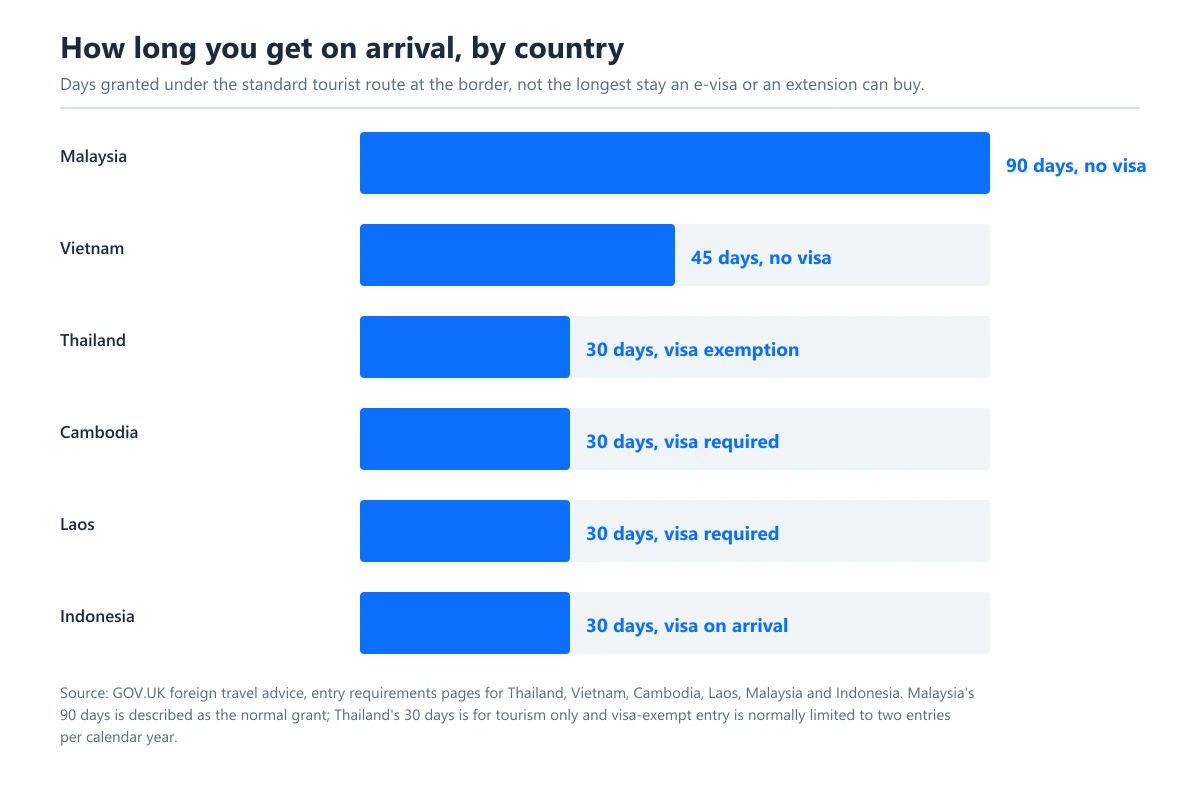
Thailand caps visa-exempt entry at two arrivals per calendar year. The line sits halfway down the UK’s Thailand entry requirements page, under a heading most people scroll past, and it breaks the obvious move in the region: leave for Cambodia, come back, leave for Laos, come back. Your third arrival needs a visa you never applied for.
Entry rules for a multi-country trip are not one rule. Six countries means six systems that disagree about how long a passport must last, how many blank pages it needs, and what you have to prove at the counter.
Every figure comes from a government page read in full, and each one is linked where it is used. The order below matters as much as the numbers themselves.
What these pages assume about you
The six pages behind this article are the entry requirements sections of the UK’s foreign travel advice, and all six carry the same caveat: they are written for people holding a full British citizen passport issued in the UK. Every country sets its own.
Those pages also carry the advice level that decides whether a travel insurance policy still applies. Our guide to how the official advice levels affect travel insurance covers the side of the same document readers skip.
If your passport is not British
If you hold a United States, Canadian or Australian passport, work from the page your own government publishes: State Department country information, the Government of Canada’s travel advisories, and Smartraveller. The numbers below are the UK’s, and all assume a British passport.
Hence six country names in the table, not one regional rule.
Six countries, four numbers each
Four numbers decide the first border: how long your passport stays valid, how many blank pages it has free, whether you need a visa, and how long the arrival is for.
| Country | Passport valid for | Blank pages | What the rule grants on arrival |
|---|---|---|---|
| Thailand | 6 months after arrival | 1 | 30 days, visa exemption, tourism only, normally two entries a year |
| Vietnam | 6 months after arrival | 2, undamaged | 45 days without a visa; e-visa: 90 days, multiple entry |
| Cambodia | 6 months from arrival | No number stated; undamaged and complete | Visa required; tourist visa 30 days from entry |
| Laos | 6 months after arrival | 2 | Visa required; tourist visa 30 days from arrival |
| Malaysia | 6 months after arrival | No number stated; undamaged, no pages missing | No visa for tourism; normally 90 days on arrival |
| Indonesia | 6 months after arrival | 2 | Visa required; 30-day visa on arrival, single entry |
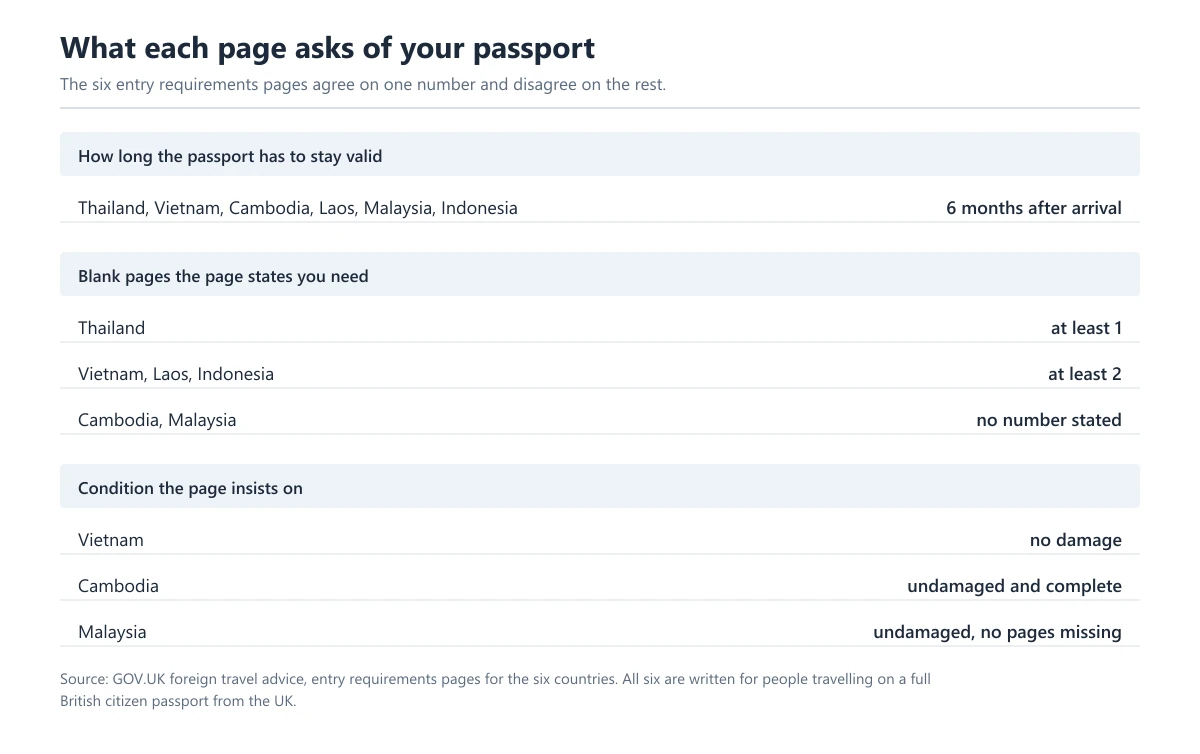
The blank-pages rule is where the six disagree
Validity is the one number all six agree on, and not the six-month rule most people mean. It counts from the date you arrive, so the test moves with you: a passport with eight months left when you fly out can fail on the last country of the route.
Thailand asks for one. Vietnam, Laos and Indonesia ask for two. Cambodia’s page states no number, and Malaysia’s does not either. Only Laos says out loud why the count matters: “Airlines will only let you board your flight if your passport has enough blank pages.”
The useful number is not the blank pages you have now. It is the pages left afterwards.
Two pages attach a condition no page count covers. Vietnam’s says the passport must have “no damage”, and notes that British nationals have been denied entry and exit because of it. Cambodia refuses entry on a passport that is not “undamaged and complete”. Malaysia asks for one that is “undamaged, with no pages missing”.
The two checks that happen before the border
Border officers ask for documents, by which point it is too late. Airlines and online arrival forms ask far earlier, and that is where a multi-country route goes wrong: each country built its own version of the card handed out on the plane.
The paper card on the plane is gone
Thailand replaced that card first. Since 1 May 2025, the page says, “all foreign nationals entering Thailand, whether by air, land or sea must complete a digital arrival card online before arrival”, and it can be registered within three days of the crossing. Cambodia’s electronic Arrival Card has to be submitted within seven days before arrival if you land at Phnom Penh, Siem Reap or Sihanoukville. Malaysia’s must be in before you travel, because airlines may ask for it at check-in.
Laos goes further. Its digital immigration form applies at Wattay, Luang Prabang, Pakse and the Lao-Thai Friendship Bridge I, and has to be completed “within 3 days before arrival and 3 days before departure”. A form you must file in order to leave is easy to miss.
Vietnam is the exception. Its digital arrival card applies at Tan Son Nhat airport in Ho Chi Minh City only, and you are encouraged to complete it rather than required to.
| Country | Onward travel proof stated | Form to submit before you travel |
|---|---|---|
| Thailand | Yes: “evidence of onward or return travel”, plus funds for the stay | Digital arrival card, within 3 days of arrival |
| Vietnam | Not stated | Digital arrival card at Tan Son Nhat, encouraged not required |
| Cambodia | Not stated | e-Arrival Card, within 7 days before arrival, by air |
| Laos | Not stated | Digital immigration form, 3 days before arrival and departure |
| Malaysia | Not stated | Arrival card, submitted online before travel |
| Indonesia | Yes: “proof of your onward or return journey” | All Indonesia declaration, within 72 hours of arrival |
Onward travel is the other pre-border check, and this is where the six pages agree least. Thailand’s page warns you may be asked to show “evidence of onward or return travel” and money for your stay — “at least 10,000 Thai baht per person or 20,000 Thai baht per family” — and then adds a line to read twice: “British nationals have been refused entry for failing to provide this evidence.”
Indonesia asks for the same thing in different words: “proof of your onward or return journey”. The other four pages do not mention onward travel at all, and silence is not permission. That absence is a fact about the page, not about the border.
What to check, and in what order
This order runs from the longest lead time to the item you can still fix at the airport. Work down it once for the whole route — the six countries in our Southeast Asia backpacking route.
- Measure the passport against the last border. All six want six months of validity counted from the date you arrive, so the last country on the route decides, and its blank pages have to still be there.
- Write down what each arrival gives you. Thirty days in Thailand, Cambodia, Laos and Indonesia; 45 in Vietnam without a visa, enough for a three-week Vietnam itinerary; 90 in Malaysia.
- Start the visa applications before the flights. Cambodia’s page says to “Apply for an e-visa at least 4 days in advance”, Laos asks you to “apply at least 5 days in advance”, and Indonesia’s says to “Apply at least one week before you leave.” Those are minimums, not promises.
- Read the e-visa conditions, not only its length. Vietnam’s e-visa grants 90 days and multiple entries, but the GOV.UK page also ties you to the crossings you named when you applied.
- Assemble the onward travel evidence before the first border. Thailand and Indonesia are the two pages that state a requirement. A booked flight out is what the officer looks for.
- Put the online forms in a calendar. Three days before arrival in Thailand, seven in Cambodia, 72 hours in Indonesia, before travel in Malaysia, and both ways round a Laos crossing. None of those windows is generous.
That is an afternoon of reading for a trip crossing four borders. Two of the six steps decide whether the trip is possible.
What an extra day costs
Every one of the six pages sets a penalty for staying past the date stamped in your passport, and the amounts matter to a budget built around dorm beds.
- Thailand: “a fine of 500 Thai baht a day up to a maximum of 20,000 baht”, plus detention, deportation at your own expense and a ban of up to 10 years.
- Indonesia: “an overstay fine of 1 million rupiah a day”, plus deportation and a possible re-entry ban.
- Laos: failing to extend within 90 days brings “a fine in Lao kip worth 2,000 US dollars, deportation to your home country and a ban on returning to Laos”.
- Cambodia: “There is no limit to this fine.”
- Malaysia: a few days over the limit can mean a fine, detention and a ban.
- Vietnam: the authorities can stop you leaving until a fine is paid, and can place an exit ban on an individual.
The rule that changed on 15 September 2026
Thailand’s visa exemption was cut on that date. Entry under the exemption now runs 30 days for tourism only, and anyone who arrived earlier “will usually be allowed to stay for the period granted when you arrived”. Business travel, including conferences and meetings, is not covered.
Dated changes are the norm here. Cambodia’s electronic Arrival Card came in on 1 September 2024, Laos restored a 30-day tourist visa and two permitted extensions on 1 January 2025, Thailand’s digital arrival card started on 1 May 2025, and Vietnam began its arrival card trial at Tan Son Nhat on 15 April 2026. A rule read once before booking is a snapshot of one morning.
The fixed costs that come with the rules are small but real: Indonesia’s visa on arrival is 500,000 rupiah, and Bali adds a provincial tourist levy of 150,000 rupiah. Our breakdown of what a backpacking trip costs puts both on the fixed line.
Conclusion
None of these rules is a secret. All six are published, dated and free to read, and the only thing between you and a surprise at a land border is the order you read the pages in.
The trap is structural rather than hidden. A rule that costs nothing in one country becomes a problem on a third entry, or when the passport with eight months left in Bangkok has five when the route reaches Jakarta.
Read the six pages before booking anything, including the countries you only pass through, then read them again before departure: they carry dated changes from April and September of this year.
About the author
The Shoestring Drift editors. Shoestring Drift is written and maintained by a small editorial team that builds travel guides around published prices and official sources rather than press trips or sponsored stays. Every figure we print carries the date we checked it and a link to where it came from, and we correct articles when a reader tells us a number has gone stale. If a rule in this guide no longer matches what a border officer told you, write to us and we will re-check it.
Sources cited
- GOV.UK / Foreign, Commonwealth & Development Office (FCDO), Thailand: entry requirements — https://www.gov.uk/foreign-travel-advice/thailand/entry-requirements
- GOV.UK / FCDO, Vietnam: entry requirements — https://www.gov.uk/foreign-travel-advice/vietnam/entry-requirements
- GOV.UK / FCDO, Cambodia: entry requirements — https://www.gov.uk/foreign-travel-advice/cambodia/entry-requirements
- GOV.UK / FCDO, Laos: entry requirements — https://www.gov.uk/foreign-travel-advice/laos/entry-requirements
- GOV.UK / FCDO, Malaysia: entry requirements — https://www.gov.uk/foreign-travel-advice/malaysia/entry-requirements
- GOV.UK / FCDO, Indonesia: entry requirements — https://www.gov.uk/foreign-travel-advice/indonesia/entry-requirements
- GOV.UK / FCDO, Foreign travel advice — https://www.gov.uk/foreign-travel-advice
- Government of Canada, Travel advisories, the equivalent for non-UK readers — https://travel.gc.ca/travelling/advisories

Related Posts