Carry On Only Backpacking: What You Leave Behind
Last updated: 28 September 2026. Rules checked against the sources listed at the end of this article.
No screwdriver. No pliers, no corkscrew, no hiking poles, no pocket knife, no camping stove.
That is what a month with cabin baggage only looks like from the inside. The decision is sold as freedom — skip the carousel, skip the wait, travel light — and the first thing it produces is a list of ordinary objects you stop travelling with.
Some of that list is choice. Most of it is not: the rules take those items off a cabin bag whether the packer agrees or not, and they do it by measurement rather than by taste. It is the other half of the decision, set against what the same choice buys back.
Every rule quoted below is copied from the body that publishes it, with the link at the point of use. The limits are dated, and the reasoning is labelled as reasoning.
What you stop carrying
The UK hand luggage guide is published as tables, one per category. Every row answers two questions: may this go in hand luggage, and may it go in hold luggage.
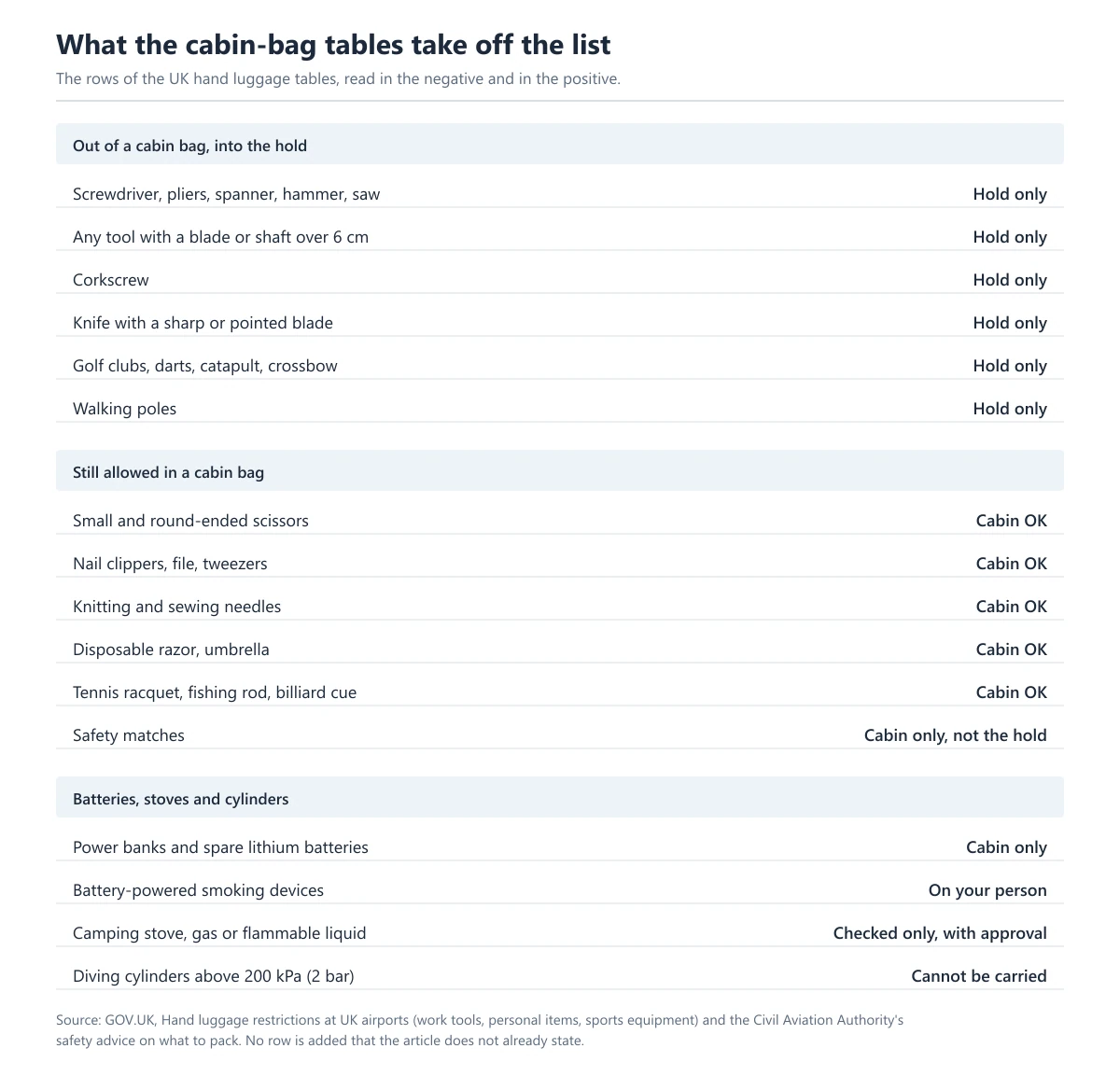
Read those rows in the negative and you have a carry-on-only packing list written by someone else. Work tools first: the government’s table lists a screwdriver, pliers, a wrench or spanner, a hammer and a saw as not allowed in hand luggage and allowed in hold luggage, and bans a drill and drill bits, a Stanley knife, a bolt gun, a crowbar, a blowtorch and any tool with a blade or shaft longer than 6cm (GOV.UK, work tools). A repair kit for a month on the road is not a weight problem. It is not allowed in the bag.
Personal items narrow it further. A corkscrew is out. So is a knife with a sharp or pointed blade, and so is a blade longer than 6cm.
What stays is longer than most people expect: small scissors, round-ended scissors, nail clippers, a nail file, tweezers, knitting needles, a sewing needle, a disposable razor and an umbrella (GOV.UK, personal items). The line drawn here is a measurement of 6cm, not a feeling about sharpness.
Sports equipment is where the tables stop matching intuition. Tennis racquets, a fishing rod and a snooker, pool or billiard cue may travel in the cabin; golf clubs, darts, a catapult, a crossbow, martial arts equipment and walking poles may not (GOV.UK, sports equipment).
For anyone whose month includes a trek, the walking pole is the item that table takes away.
One row inverts the logic, which is worth knowing before you rely on memory: safety matches are allowed in hand luggage and not allowed in hold luggage, while non-safety matches are allowed in neither.
Batteries push the other way, and this is the one category where carry-on only is already the rule. The Civil Aviation Authority’s table lists power banks as not permitted in checked baggage, spare lithium batteries as carry-on only, and requires battery-powered smoking devices to be carried on your person (CAA, what items can I travel with). A packer who never checks a bag satisfies all of it without thinking.
Two more rows matter, and only one of them closes a door. A camping stove fuelled by gas or flammable liquid “may be carried as checked baggage, once approved by the operator”, so in a cabin bag it cannot fly at all, however small it is. The CAA’s table also states that “Diving Cylinders that are above 200 kPa (2 bar or 29 psi) cannot be carried.” That one is a limit on the cylinder rather than on the bag, and it does not single out carry-on travel: the same table permits cylinders below that threshold, so what a diver has to settle is the cylinder’s rating rather than the size of the bag it flies in.
The framing sentence for the whole list: “The permitted dangerous goods may only be carried when for personal use.”
The two columns, faced off
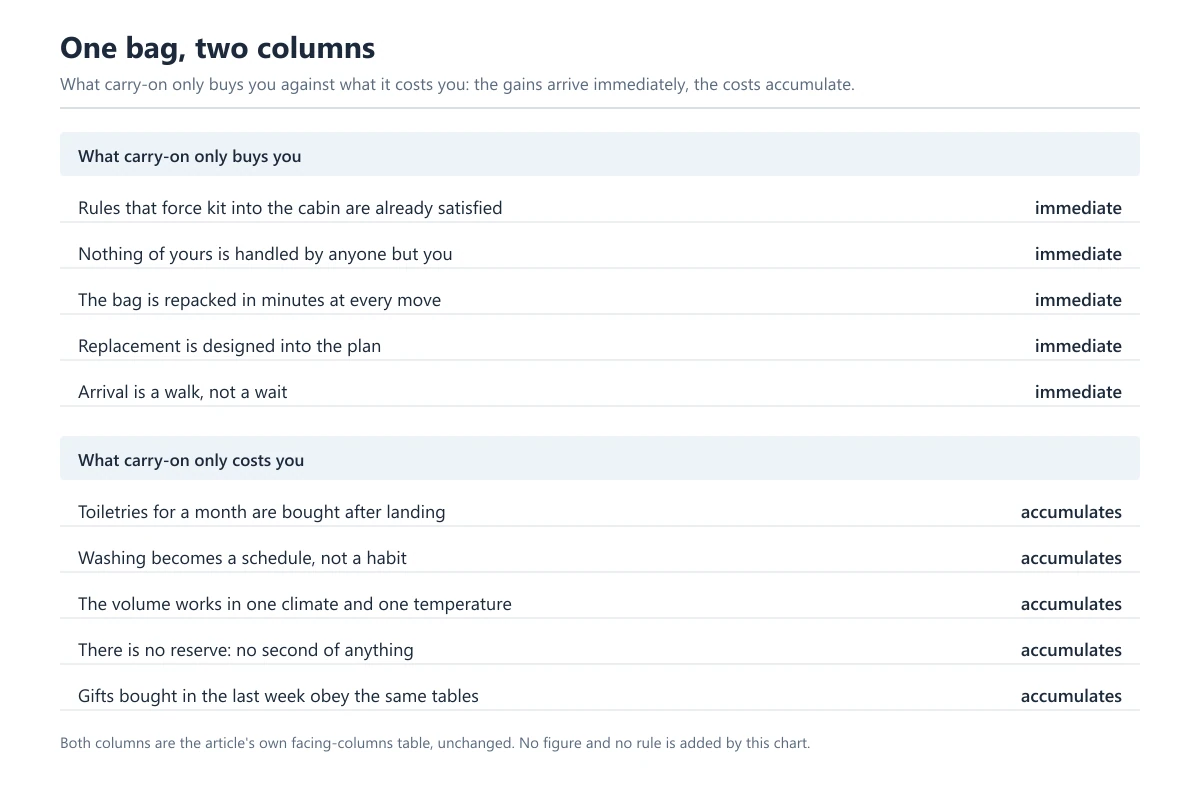
The gains and the costs are not symmetrical, and putting them side by side is the only way to see why. One column arrives immediately. The other accumulates across the month.
| What carry-on only buys you | What carry-on only costs you |
|---|---|
| Rules that force kit into the cabin are already satisfied | Toiletries for a month are bought after landing |
| Nothing of yours is handled by anyone but you | Washing becomes a schedule, not a habit |
| The bag is repacked in minutes at every move | The volume works in one climate and one temperature |
| Replacement is designed into the plan | There is no reserve: no second of anything |
| Arrival is a walk, not a wait | Gifts bought in the last week obey the same tables |
The column on the left: what one bag buys you
Most of the left column comes from one fact: the bag never leaves your hands.
The rules that govern the cabin are written for people who are also checking a bag. Carry-on only removes that ambiguity: there is nothing to repack at the desk, and no last-minute transfer of the item that would have been taken off you.
A month of buses, trains and short flights means the pack is handled dozens of times, and every handover is a point at which a bag can be separated from its owner. A bag that never enters the hold cannot be separated by the handling system at all: that failure mode is not reduced, it is absent. This is an argument, not a statistic.
The third gain is economic, and it makes the rest of the plan defensible. Replacement only works as a strategy where replacement is cheap, which is why this decision fits a long route through the countries our budget comparison covers and fits badly inside a fortnight of expensive cities.
Arrival is the fourth. There is no carousel to stand at and no bag to wait for.
The column on the right: what one bag costs you
The right-hand column starts with volume, and volume does not negotiate. The UK government’s advice is to “pack liquids in your hold baggage”. Carry-on only is a decision to do the opposite.
The consequence is a shopping trip in the first day or two of every leg. Shampoo, sunscreen, insect repellent and anything else used daily get bought where you are instead of carried from home. Over a month that is a recurring line, and it belongs with the in-country running costs in our method for building a backpacking budget.
Washing is the second cost, and the one people underestimate. A month of clothes does not fit in a cabin bag; a week of clothes does. The trip becomes four or five wash cycles instead of one packing job, which turns a machine, a laundrette or a sink into a practical requirement — and turns how you choose a hostel into a packing decision.
Climate is the third. The same bag that carries a month of warm-weather travel stops closing the moment a coat, boots and a second layer have to fit.
Souvenirs are the fourth, and they bite on the way home. Alcohol for personal use is capped by the CAA at no more than 5 L total net quantity per person, in retail packaging, and only for drinks between 24% and 70% alcohol by volume (CAA, what items can I travel with). Anything on the tool, blade or sports tables cannot travel in the cabin either.
And there is no reserve. Nothing in the bag is a spare for anything else.
Read the two columns together and the trade stops being philosophical. Carry-on only is cheap for a warm, slow, laundry-friendly trip and expensive for a cold, fast one.
What a month or more changes
Thirty days does not need a bigger bag. It needs a different relationship with what is in it.
The volume that works for a week works for a month, because washing replaces packing as the thing you do repeatedly. Divide thirty days by seven and the answer is four or five washes.
That has a consequence the two columns do not show: wear happens mid-trip. Zips, straps, soles and chargers reach the end of their working life in the middle of a route, in a place where a replacement exists but is not the same object.
One category cannot be replaced by shopping at all.
Medication is the exception, and the reason this decision needs planning rather than discipline. The CAA states that “Essential medicines are allowed in your hand luggage”, and adds that where the medicine is a liquid and the amount is more than 100ml, you should carry “a prescription with your name on it or a letter from a medical professional” (CAA, what items can I travel with). On a route this long that paperwork travels with the passport rather than at the bottom of the pack, and a month’s supply takes up room the rest of the list has to give up.
Season is the last variable. A trip short enough to sit inside one season can be packed once; a longer one can cross a boundary, so the useful question is whether the same bag still closes on the last day.
Who decides, and what they publish
Two authorities decide what may go in the bag, and neither publishes a limit that answers the question for you.
The first is the airline. The government’s instruction is to “Check with your airline how many and what size bags you can take on the plane with you” (GOV.UK, hand luggage restrictions), because the size and weight of the bag are the carrier’s rule rather than one published for everybody flying that day.
The second authority is less predictable.
Individual airports have discretion to confiscate anything they consider dangerous, regardless of whether or not it appears on the list of prohibited articles […]
That is the Civil Aviation Authority’s own sentence, quoted up to the point where the original continues into a clause about passengers who have queries (CAA, what items can I travel with). GOV.UK puts the same position from the other side: “Airport security staff will not let anything through that they consider dangerous” (GOV.UK, hand luggage restrictions). A published table is therefore a floor rather than a ceiling, and an unusual item is a question for the airline before the day of travel rather than an argument at the tray.
Those two facts make this a decision instead of a checklist. The question is not whether the bag fits a limit; it is how much uncertainty can be absorbed at a security lane with a queue behind you and a flight to catch.
For US departures the equivalent list is published by the Transportation Security Administration (TSA, What Can I Bring?), and for the limits themselves — liquids, batteries, what the bag may hold — the detail is in our backpacking packing list.
That leaves the test the decision has to pass. It holds when the route stays inside one climate, when laundry is available along it, and when the carrier’s allowance covers the volume the trip needs. Where any of the three fails, the honest answer is a checked bag.
Conclusion
Carry-on only is not a lighter way of packing a suitcase. It is a different set of problems.
The gains are immediate and structural: the rules that push batteries and smoking devices into the cabin are satisfied by default, nothing of yours is out of your sight, and replacement becomes part of the itinerary rather than a failure. The costs arrive later, and they are paid in both money and time.
So decide it deliberately rather than romantically. Check the airline’s allowance, read the airport’s own tables the week you fly, and work out whether your route’s climate and its laundry will carry the right-hand column. If they will not, check a bag — and take the walking poles.
About the author
The Shoestring Drift editors. Shoestring Drift is written and maintained by a small editorial team that builds travel guides around published prices and official sources rather than press trips or sponsored stays. Every figure and rule we print carries the date we checked it and a link to where it came from, and we correct articles when a reader tells us something has gone stale. If a rule in this guide no longer matches what you were told at the airport, write to us and we will re-check it.
Sources cited
- GOV.UK, Hand luggage restrictions at UK airports — Overview — https://www.gov.uk/hand-luggage-restrictions
- GOV.UK, Work tools, source of the tool table and the 6cm rule — https://www.gov.uk/hand-luggage-restrictions/work-tools
- GOV.UK, Personal items, source of the corkscrew, knife, scissors and matches rows — https://www.gov.uk/hand-luggage-restrictions/personal-items
- GOV.UK, Sports equipment, source of the walking poles row — https://www.gov.uk/hand-luggage-restrictions/sports-equipment
- UK Civil Aviation Authority, What items can I travel with and which are restricted, source of the battery rows, the camping stove restriction, the diving cylinder limit, the 5 L alcohol cap and the medicine rule — https://www.caa.co.uk/air-passengers/about-your-trip/baggage/safety-advice-on-what-to-pack/
- US Transportation Security Administration, What Can I Bring?, cited as the reference list for departures from the United States — https://www.tsa.gov/travel/security-screening/whatcanibring/all


Related Posts