Cheapest Countries to Travel on a Budget in 2026
Last updated: 28 September 2026. Figures checked against the sources listed at the end of this article.
UN Tourism counted 1.52 billion international arrivals in 2025, a 4% rise on the previous year and roughly 60 million more travellers than 2024 (UN Tourism, World Tourism Barometer, 20 January 2026). The interesting question is not how many people travel, but how little some of them manage to spend doing it.
So which countries actually stretch a modest budget furthest? Not the ones usually named. We pulled current price data for five of the most popular low-cost destinations in Asia and put them side by side, converted to a single currency on a single date, so the comparison means something.
What it shows is that the ranking depends on how you travel — and that the honest answer changes the moment you change the question.
The short answer, before the detail
On the daytime basket below, Vietnam comes out cheapest at $8.65 a day, with Indonesia at $8.89 and Nepal at $9.26 close behind. But Nepal has the cheapest local transport and the cheapest bottled water of the five, so if your trip involves a lot of short journeys it overtakes both. The ranking is real; it just depends on which line you weight most — and that is exactly what the headline numbers hide.
How we built this comparison
Every figure in the table comes from Numbeo’s cost-of-living database, which aggregates prices submitted by residents and visitors. We used the country-level data current as of September 2026 and converted everything at a single exchange rate dated 27 September 2026 (source: exchangerate-api.com). One rate, one date — so the differences you see are between countries, not between conversion dates.
Three limits you should know before you use these numbers:
- Numbeo figures are crowd-sourced, not audited. They are a useful signal, not a price list. Treat them as a starting range.
- Country averages hide city spread. A meal in Jakarta and a meal in a Bali beach town are not the same purchase. Neither are Hanoi and a Vietnamese island.
- They exclude the costs that actually wreck budgets: long-distance transport, visas, insurance and the nights you overspend because you are tired.
We flag all three again where they matter below.
The five countries, compared
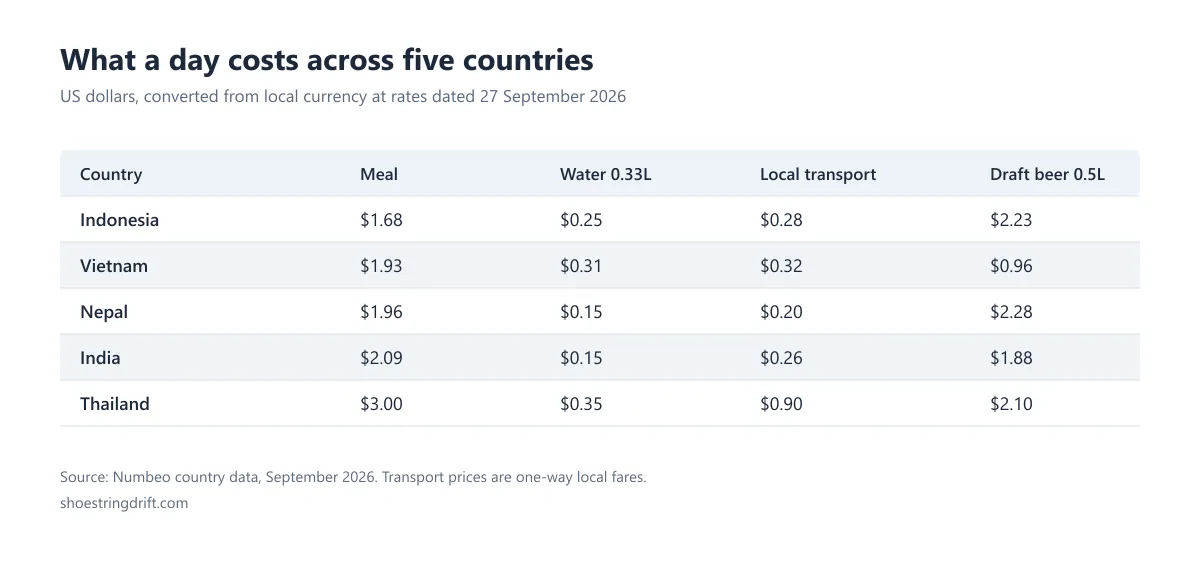
Prices in US dollars, converted from local currency at 1 USD = 25,952.11 VND, 33.39 THB, 17,897.90 IDR, 95.88 INR and 153.41 NPR.
| Country | Meal, inexpensive restaurant | Bottled water (0.33L) | One-way local transport | Domestic draft beer (0.5L) |
|---|---|---|---|---|
| Indonesia | $1.68 | $0.25 | $0.28 | $2.23 |
| Vietnam | $1.93 | $0.31 | $0.32 | $0.96 |
| Nepal | $1.96 | $0.15 | $0.20 | $2.28 |
| India | $2.09 | $0.15 | $0.26 | $1.88 |
| Thailand | $3.00 | $0.35 | $0.90 | $2.10 |
Source: Numbeo country data, September 2026. Conversion: exchangerate-api.com, 27 September 2026.
Read that table carefully and two things stand out that the headline rankings always miss.
The gap between first and last is smaller than you think
The most expensive meal in this group, Thailand at $3.00, costs less than double the cheapest, Indonesia at $1.68. On food alone, the difference between the top and the bottom of the table is about $1.32 a meal. Over a month of three restaurant meals a day, that is roughly $119 — real money, but not the gulf the internet implies.
Transport is where the ranking actually moves
Look at the local transport column. Nepal is $0.20 a ride; Thailand is $0.90. That is a 4.5x difference on a cost you pay several times a day. A traveller taking four local trips daily spends about $0.80 in Nepal and about $3.60 in Thailand — and that gap compounds faster than the food gap does.
What a day actually looks like
Using only the figures above, three inexpensive restaurant meals, four local transport trips, two bottles of water and one beer come to:
- Indonesia: $8.89 a day
- Vietnam: $8.65 a day
- Nepal: $9.26 a day
- India: $9.49 a day
- Thailand: $15.40 a day
Every derived figure in this article is calculated from the rounded unit prices shown in the table above, so you can reproduce the arithmetic with the table in front of you.
These are daytime survival costs, not daily budgets. They exclude a bed, long-distance transport, visas, insurance, entry fees, laundry, SIM data and everything you will actually want to do. A realistic backpacker day in this region typically lands well above these numbers once accommodation is added, and accommodation is the single largest line.
That is the trap in every “you can live on $10 a day” claim: it is arithmetic on a subset of costs, presented as a total.
Where the rankings break down
A national average is a starting point, not an answer — and that difference can be wide enough to change which country you should pick.
The country table above hides a 59% gap in India
We pulled the same indicators for the cities a backpacker actually lands in, and the ranking moves more than you would expect. Numbeo also publishes a range and a sample size for each figure, so both are shown here — an average with no spread attached is only half a number.
| City | Daily basket | Country average | Diff. | Meal | Meal range | Local fare | Sample |
|---|---|---|---|---|---|---|---|
| Denpasar (Bali) | $8.78 | $8.89 | −$0.11 | $1.82 | $1.12–2.23 | $0.25 | 16 |
| Ho Chi Minh City | $9.20 | $8.65 | +$0.55 | $2.10 | $1.54–4.62 | $0.27 | 111 |
| Hanoi | $9.38 | $8.65 | +$0.73 | $2.02 | $1.54–3.85 | $0.39 | 86 |
| Kathmandu | $9.95 | $9.26 | +$0.69 | $1.96 | $0.98–3.26 | $0.20 | 71 |
| Jakarta | $12.10 | $8.89 | +$3.21 | $2.65 | $1.40–3.91 | $0.28 | 174 |
| Delhi | $15.06 | $9.49 | +$5.57 | $3.65 | $2.09–10.43 | $0.42 | 258 |
| Phnom Penh | $16.41 | — | — | $4.00 | $2.50–9.00 | $0.45 | 37 |
| Bangkok | $16.76 | $15.40 | +$1.36 | $3.00 | $1.80–7.49 | $1.09 | 200 |
Same basket as above — three meals, four local transport trips, two bottles of water and one beer. Source: Numbeo city pages, September 2026, converted at the same rate. “Sample” is the number of contributors behind each city’s figures.
Read the ranges before the averages. A meal in Bangkok ranges from $1.80 to $7.49, and in Delhi from $2.09 to $10.43. The average tells you where the middle sits; the range tells you how wrong you can be if you land in the wrong part of town. Budget from the top of the range and you will not be surprised.
And read the sample sizes. Denpasar’s figures rest on 16 contributors, against 258 for Delhi. It is still the cheapest basket in the table, but it is also the least certain — treat that first place as provisional rather than settled.
The India figure is the one that matters most. On national averages, India looks like the fourth-cheapest place to eat. In Delhi it costs $3.65 for a meal, 59% above the national average, which makes Delhi the second most expensive city on this list rather than one of the cheapest. If you had budgeted India from the country figure, you would be wrong by more than five dollars a day before you paid for a bed.
Bali is cheaper than the national average, not more expensive
The obvious assumption is that Indonesia’s tourist islands cost more than the country average. For Denpasar, the island’s capital, the data says the opposite: it has the cheapest basket of all eight cities and comes in slightly below the Indonesian national figure. Jakarta, not Bali, is where the money goes.
What this does not tell you: Numbeo measures Denpasar, not the tourist strips of Kuta, Seminyak or Ubud, which are certainly dearer. So do not read this as “Bali is cheap everywhere”. Read it as “the island’s capital is not the expensive part” — and check the specific town you are going to.
Nepal is cheaper on paper than on the ground
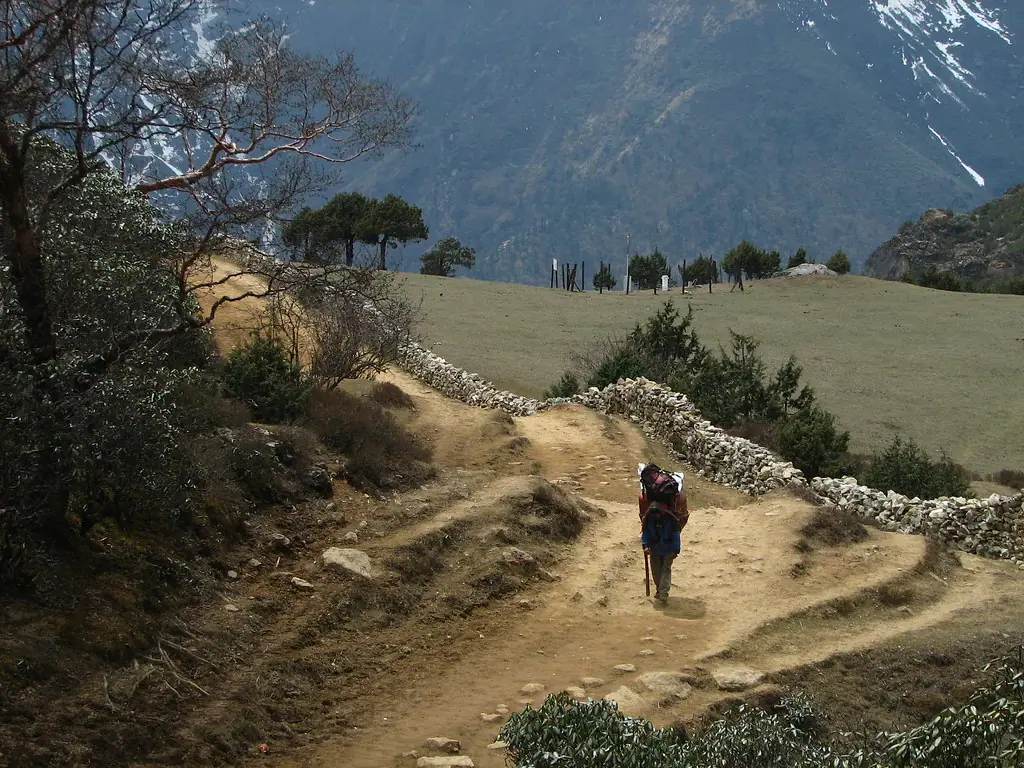
Kathmandu tracks the national average closely, so Nepal’s problem is not the city figures — it is that they stop applying the moment you leave. Trekking regions run on supplies carried in by hand, and prices rise with altitude and remoteness in a way no city average captures.
Thailand’s transport is the line to watch
Bangkok’s local fare comes out at $1.09 against a national average of $0.90 — a fifth higher. On a city break that is nothing. Over a month of four trips a day it is around $23 more than the country figure suggested, and it is the clearest example of why the national number understates the capital.
What all of this means for picking a country
Read the two tables together and a rule appears: national averages are good for eliminating options and bad for choosing one. Use them to cut the list down, then check the city you are actually flying into before you commit a budget to it. The cities on this route differ from their own countries by anywhere from nothing to 59%, and that spread is bigger than the gap between most countries on the list.
Thailand costs more and delivers more
Thailand is the most expensive of the five on almost every line, and it is still on this list for a reason: transport is fast, the tourism infrastructure is mature, and the gap between a planned day and reality is smaller than anywhere else here. A higher daily number that you can actually predict often beats a lower one that keeps surprising you.
The answer depends on the shape of your trip
There is no single cheapest country, because the ranking changes with how you travel. Three shapes cover most trips.
Staying put for a month or more. Food and accommodation decide everything, and local transport barely registers. Vietnam and Indonesia are effectively level on the basket above, so pick whichever you actually want to be in — the cost difference is smaller than the difference one badly chosen hostel makes.
Moving every few days. Transport takes over and the ranking inverts. Nepal’s $0.20 local fare and India’s $0.26 beat Thailand’s $0.90 by enough to absorb a higher food bill. That is why the cheapest country for a fast trip is not the cheapest country for a slow one, and why the two lists rarely agree.
Travelling for six months or more. The fixed costs — flight, visas, insurance — stop mattering per day, and the daytime basket becomes almost the whole budget. At that point the only decision still moving the number is how often you move.
Every answer above arrives with a condition attached. That is a worse headline and a better guide, and it is the reason this article does not simply end with a ranking.
For the arithmetic that turns any of these into a real figure, see our guide to how much it costs to backpack.
Accommodation is the line that decides the trip
The four indicators in that table cover a little over 40% of a real in-country budget. That figure is not a guess: it comes from the worked model in our guide to what a backpacking trip costs, where daytime spending of $15.40 sits inside a daily running cost of $35.57 — 43%. Accommodation is the other large one, and it is where the country ranking and the real experience diverge most.
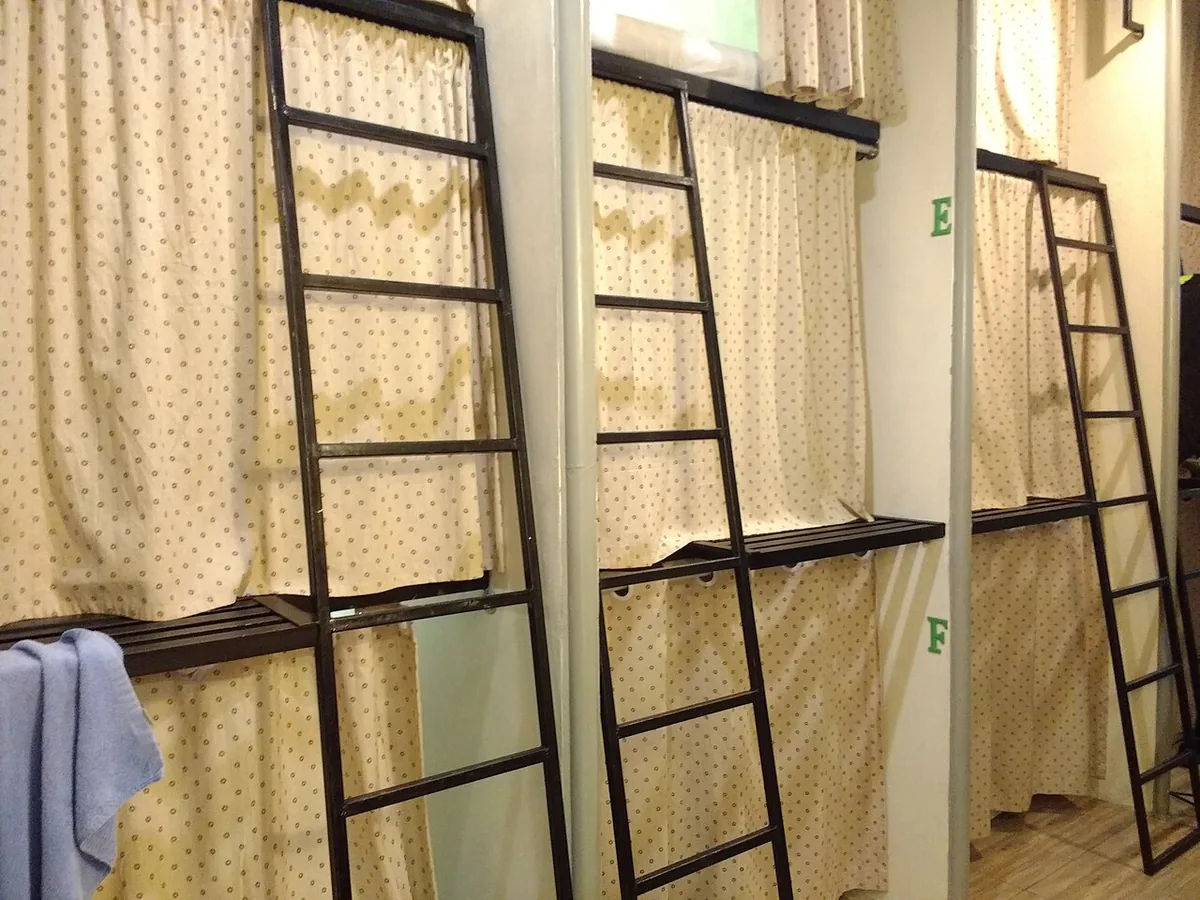
A dorm bed in a well-run hostel and a dorm bed in a badly run one can differ by more than the entire daily food budget of the country you are standing in. The gap is rarely the city. It is whether the air conditioning works, whether the lockers actually lock, and whether the place sits on a transport line or forty minutes outside town. A cheap bed in the wrong location costs more in taxi fares and lost mornings than a slightly better bed in the right one.
That is why this guide does not publish a “cheapest bed” ranking. Bed prices swing with season, with how far ahead you commit and with how many beds the property has left, and a national average for accommodation tells you almost nothing you can act on.
Verify the figures before you commit
Prices in this region move. Fuel costs, seasonal demand and exchange rates all shift the numbers above, so a table dated September 2026 will be wrong about something by the time you fly. That is not a flaw in the data — it is how travel pricing works.
Check the current Numbeo entry for your specific destination city rather than the country, and check it again the week you book. If a figure in this article is out of date when you read it, tell us: correcting stale prices is the most useful thing a reader can send us.
Conclusion
Indonesia, Vietnam, Nepal and India all land within roughly a dollar of each other on the cost of a meal, and Thailand sits above all four on food, water and local transport while being the easiest of the five to travel predictably. The honest ranking depends less on the country than on how you move through it: transport costs and accommodation decide your budget far more than the price of lunch.
Before you commit to a route, check your own government’s current advice for the countries on your list — entry rules and regional advisories change, and no cost table can tell you whether a border is open. Start with the UK FCDO travel advice or Government of Canada travel advisories, then build your route around what they say. Our Southeast Asia backpacking route shows how to sequence these countries without doubling back on transport you have already paid for.
About the author
The Shoestring Drift editors. Shoestring Drift is written and maintained by a small editorial team that builds travel guides around published prices and official sources rather than press trips or sponsored stays. Every cost figure we print carries the date we checked it and a link to where it came from, and we correct articles when a reader tells us a number has gone stale. If a price in this guide no longer matches what you paid, write to us and we will re-check it.
Sources cited
- UN Tourism, International tourist arrivals up 4% in 2025 reflecting strong travel demand around the world, 20 January 2026 — https://www.untourism.int/news/international-tourist-arrivals-up-4-in-2025-reflecting-strong-travel-demand-around-the-world
- Numbeo, Cost of Living country data, September 2026 — https://www.numbeo.com/cost-of-living/
- exchangerate-api.com, exchange rates dated 27 September 2026 — https://www.exchangerate-api.com
- UK Foreign, Commonwealth & Development Office, Foreign travel advice — https://www.gov.uk/foreign-travel-advice
- Government of Canada, Travel advisories — https://travel.gc.ca/travelling/advisories

Related Posts