What a Day Costs in Bangkok, Hanoi and Kuala Lumpur
Last updated: 28 September 2026. Figures checked against the sources listed at the end of this article.
Numbeo’s page for Bangkok carries a line that reads like a typing error: “Bangkok has 2nd Most Expensive Eggs (12, Large Size), Markets in South-Eastern Asia out of 23 cities).”
Eggs, in a city whose street food is the reason people book the flight.
That line is the most useful thing on the page, and not because of the eggs. It is a warning about the number printed beside every price on the site. An average says what a thing costs on a normal day, and nobody gets to choose their days.
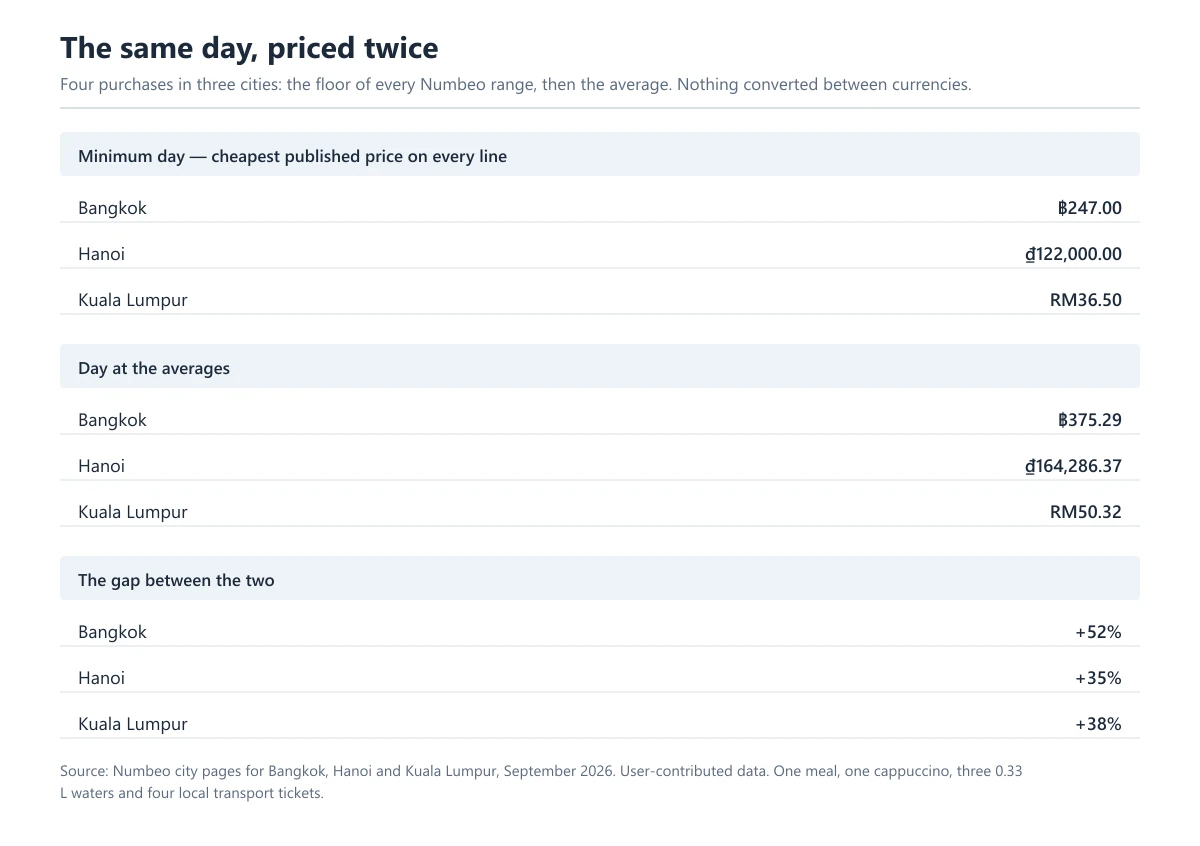
In Bangkok, four ordinary purchases cost ฿247.00 at the floor of every range Numbeo prints, and ฿375.29 at the averages. That is a 52% gap between the same day and the same day.
Budget from the average, then, and the floor is a number you will never see.
The figure that does not fit
The ranking sits in Numbeo’s own box of rankings and history at the foot of the Bangkok page, and it is worth reading twice, because the sentence names the category it belongs to: Markets. Twelve large eggs, priced as groceries, second most expensive of the 23 cities in South-Eastern Asia that the ranking covers.
The same page puts twelve large eggs at ฿86.59. Hanoi’s page puts them at ₫38,350.00. Kuala Lumpur’s puts them at RM10.33. Three cities, three currencies, and no way to line those numbers up: converting them would need an exchange rate, and a rate is a fourth number with its own date and its own source. Nothing in this article is converted. Every figure stays in the currency Numbeo prints for that city.
What can be compared is one city against itself, over time, because Numbeo prints that too. Bangkok’s dozen eggs cost ฿62.06 in 2015 and ฿86.59 now, up 40%. Hanoi’s went from ₫33,950.00 to ₫38,350.00, up 13%. Kuala Lumpur’s went from RM5.20 to RM10.33 — up 99%, or very nearly double in eleven years.
Same item, same source, same method, three different stories. The averages alone would never have told you that a dozen eggs can move 13% in one of these cities and 99% in another. That is the case for reading the range as carefully as the number in the middle of it. Country-level figures have the same problem one level up, which is why our comparison of the cheapest countries in the region and the three city pages here answer different questions.
Where these numbers come from
Numbeo’s prices are user-generated. Its pages invite residents to add their own, and each page reports how many did: Bangkok’s says 1,298 entries in the past 12 months by 200 different contributors, Hanoi’s 869 by 86, and Kuala Lumpur’s 1,085 by 161. Nobody audits those entries, and Numbeo does not claim otherwise. They are a crowd’s record of what things cost, which is a different thing from an inspected price list.
Each page also carries its own last-update date, and the three do not agree. Bangkok and Kuala Lumpur were both updated on 27 September 2026. Hanoi’s page was last updated on 9 September 2026, eighteen days earlier, so its figures are the least recent of the three sets used here. One more property of the site matters for everything below: beside every average Numbeo prints a range, and those ranges are usually wider than the gaps between the three cities. The averages are the middle of each range and not the edge of it.
The minimum day, priced at the floor of every range
A minimum daily budget gets built the same way almost everywhere: take the cheapest version of each thing you are certain to buy. Numbeo’s ranges allow that to be done literally rather than guessed at, because the bottom of a published range is a price somebody actually reported. The day below is four purchases chosen here, not by Numbeo: one meal in an inexpensive restaurant, one regular cappuccino, three 0.33-litre bottles of water, and four one-way local transport tickets. Three small bottles is a litre of water.
| Line, one day | Bangkok (฿) | Hanoi (₫) | Kuala Lumpur (RM) |
|---|---|---|---|
| Meal, inexpensive restaurant — floor of range | 60.00 | 40,000.00 | 12.00 |
| Cappuccino, regular — floor of range | 60.00 | 35,000.00 | 8.00 |
| Bottled water, 0.33 L × 3 — floor of range | 27.00 | 15,000.00 | 4.50 |
| One-way local transport ticket × 4 — floor of range | 100.00 | 32,000.00 | 12.00 |
| Minimum day | 247.00 | 122,000.00 | 36.50 |
Every figure in that table is reproducible from the page for that city: multiply the small water bottle by three, the local ticket by four, and add the four lines. Derived amounts are calculated from the unit prices as Numbeo prints them, to two decimals. Bangkok’s floor is fragile on its own numbers: the one-way ticket ranges from ฿25.00 to ฿61.00, so the floor is less than half the ceiling. Kuala Lumpur’s is the other case. There the floor and the average are the same number, RM3.00, so the cheapest published price and the typical published price cannot be told apart.
The real day, priced at Numbeo’s averages
Same four purchases, same order, this time at the averages Numbeo publishes for them. Nothing else changes.
| Line, one day | Bangkok (฿) | Hanoi (₫) | Kuala Lumpur (RM) |
|---|---|---|---|
| Meal, inexpensive restaurant | 100.00 | 52,500.00 | 20.00 |
| Cappuccino, regular | 94.37 | 48,786.36 | 12.62 |
| Bottled water, 0.33 L × 3 | 34.92 | 23,000.01 | 5.70 |
| One-way local transport ticket × 4 | 146.00 | 40,000.00 | 12.00 |
| Day at the averages | 375.29 | 164,286.37 | 50.32 |
| Difference from the minimum day | +128.29 | +42,286.37 | +13.82 |
| Difference as a share of the minimum | +52% | +35% | +38% |
Bangkok’s day costs ฿128.29 more than its own floor, Hanoi’s ₫42,286.37 more, Kuala Lumpur’s RM13.82 more. As a share of the floor, the widest gap is Bangkok’s and the narrowest is Hanoi’s.
The line that moves most is not the same line in all three cities. In Bangkok it is transport: four tickets go from ฿100.00 to ฿146.00, a rise of ฿46.00, the largest single contribution to the ฿128.29. In Hanoi the cappuccino moves most, from ₫35,000.00 to ₫48,786.36, which is ₫13,786.36 — more than the meal line’s ₫12,500.00 rise. In Kuala Lumpur the meal line does most of the work, from RM12.00 to RM20.00, while transport contributes nothing at all, because the average is already the floor.
Why neither table is a budget
No bed appears in either table, and a bed is the largest line in most backpacking days. Numbeo prices flats by the month rather than bunks by the night — its one-bedroom city-centre figures are ฿22,561.28 in Bangkok, ₫10,513,946.61 in Hanoi and RM2,525.00 in Kuala Lumpur, and a monthly lease is not a traveller’s night.
The second reason is in the arithmetic. A floor is achievable; a floor held on all four lines on the same day, every day, is not. The gap measures the distance between a best case and a normal one, not an error in the data. Our walkthrough of building a trip budget line by line applies the same reasoning across a whole journey rather than a single day, which is where the compounding gets uncomfortable.
Two small purchases that decide the difference
Of the four lines, the coffee and the water behave least like the rest of the day.
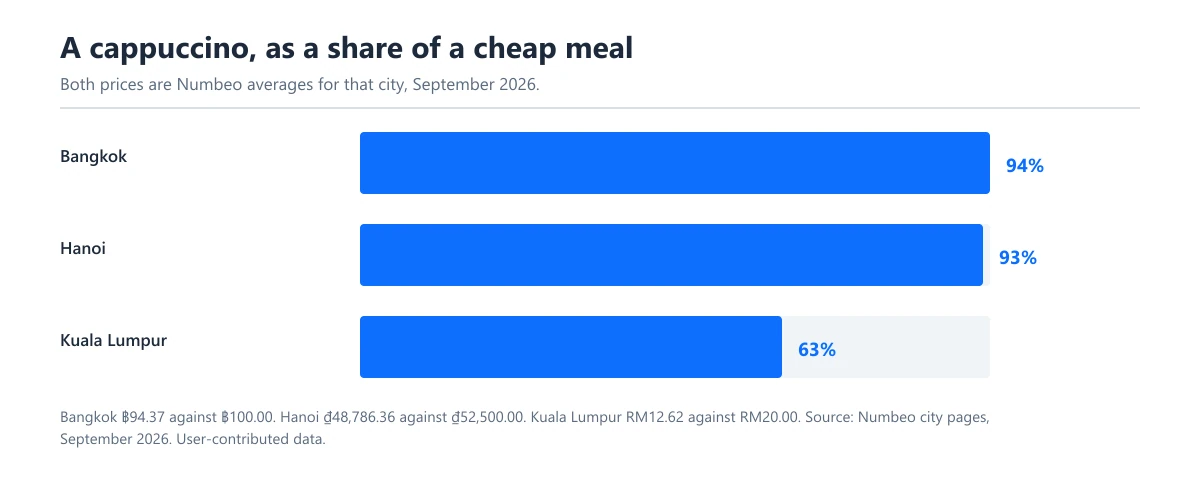
Start with the coffee. In Bangkok a regular cappuccino is ฿94.37 and a meal in an inexpensive restaurant is ฿100.00, so the coffee costs 94% of the meal. In Hanoi it is ₫48,786.36 against ₫52,500.00, or 93%. In Kuala Lumpur it is RM12.62 against RM20.00, or 63%. A budget that assumes cheap food comes with a cheap coffee is correct in one of these three cities and wrong in the other two.
Water is the stranger case. Numbeo lists the small bottle in its Restaurants table and the 1.5-litre bottle in its Markets table, and once both are reduced to a litre the two prices are not close.
| Bottled water, per litre | Bangkok (฿) | Hanoi (₫) | Kuala Lumpur (RM) |
|---|---|---|---|
| From 0.33 L bottles | 35.27 | 23,232.33 | 5.76 |
| From 1.5 L bottles | 11.87 | 9,185.19 | 1.91 |
| Ratio | 3.0× | 2.5× | 3.0× |
Per-litre figures are the printed bottle prices divided by their volume and rounded to two decimals, and the ratio is calculated from those two rounded figures. So a litre costs about three times as much in small bottles as in large ones in Bangkok and Kuala Lumpur, and about two and a half times as much in Hanoi. The minimum day above bought its water the expensive way, because the day was assembled from the cheap end of each range and the small bottle is the cheap end of the water line. A reader who then carries the same logic into an actual day in the street will find the cheapest-looking water on the page costing the most per litre.
What the tables still leave out
Neither table contains a long-distance journey between the three cities, a visa, the flight that gets you to the region, or insurance. The first three belong to the route rather than to the day, and the sequence of the legs is the subject of our Southeast Asia route guide. Insurance is a different kind of omission, because there is no published price to put in a table: no official body publishes what a policy costs, so this site does not estimate one. The useful question about insurance is not what it costs but what it declines to pay, which is what our guide to backpacker exclusions sets out.
The day also has to include somewhere to sleep, and no dorm bed price appears anywhere among Numbeo’s items for the three cities. What can be compared from published numbers is two beds in one city once the journey to each is counted, and that method is the one in our guide to choosing a hostel without overpaying.
Add all of that and the six figures in the two tables above stop being a trip budget. What they remain is a measurement of one thing: the distance between the cheapest day the data supports and the day the data says is typical.
Conclusion
Three cities, six numbers, one pattern. Bangkok’s floor day is ฿247.00 against an average day of ฿375.29. Hanoi’s is ₫122,000.00 against ₫164,286.37. Kuala Lumpur’s is RM36.50 against RM50.32. None of the six is what a trip costs, and all six are what one day inside one city costs when the same four purchases are made twice, once at the bottom of every range and once at the middle.
The useful habit is the one the eggs ranking forced: read the range before you trust the number in the middle of it. Open the Numbeo page for the city you are actually going to, find the range beside each of the four lines used here, and build the day on the averages. Then treat the floor as a thing that exists rather than a thing that happens.
About the author
The Shoestring Drift editors. Shoestring Drift is written and maintained by a small editorial team that builds its guides from published prices and official sources rather than from press trips or sponsored stays. Every figure we print carries the date we checked it and a link to where it came from. If a price in this article no longer matches the Numbeo page it came from, write to us and we will re-check it.
Sources cited
- Numbeo, Cost of Living in Bangkok — page last updated 27 September 2026 — https://www.numbeo.com/cost-of-living/in/Bangkok
- Numbeo, Cost of Living in Hanoi — page last updated 9 September 2026 — https://www.numbeo.com/cost-of-living/in/Hanoi
- Numbeo, Cost of Living in Kuala Lumpur — page last updated 27 September 2026 — https://www.numbeo.com/cost-of-living/in/Kuala-Lumpur

Related Posts