The Travel Advice That Can Leave You Uninsured
Last updated: 28 September 2026. Figures checked against the sources listed at the end of this article.
This article is about the half of travel insurance that has nothing to do with what you do. The warnings that come to mind first — don’t rent a scooter, don’t jump off a bridge, declare the asthma — belong to the other half; this one is about the risk you carry without taking any.
Your cover can be invalidated by where you are standing.
The UK’s Foreign, Commonwealth & Development Office (FCDO) says it in one sentence, on a page about insurance rather than about safety. Where its advice for a place on your route rules out travel there, at either level, “your insurance may be invalidated”. That is not a warning about danger. It is a statement about the contract you already paid for.
Most backpackers will never read that sentence. They will read the country page for a minute, see nothing alarming at the top, and book.
What the advice actually covers
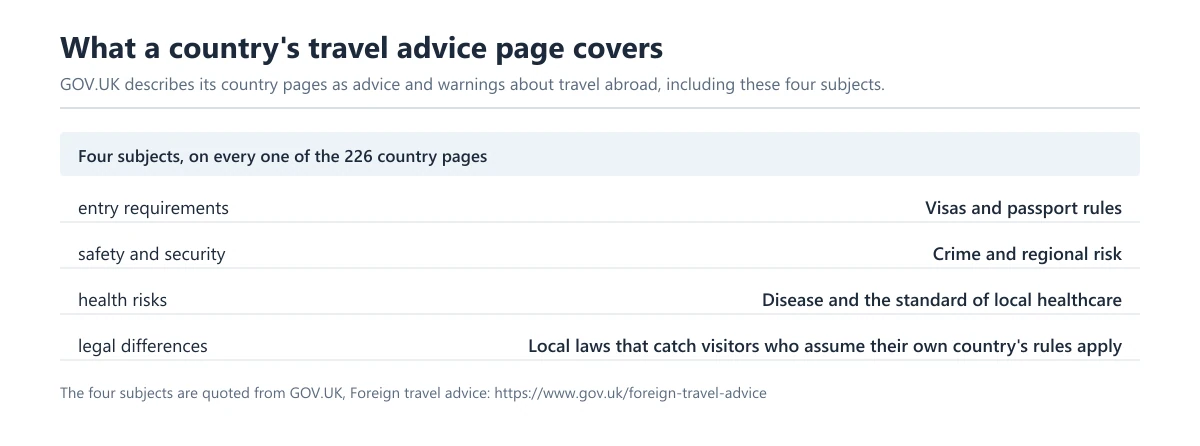
It is worth knowing what the FCDO’s country pages are, because they are not travel warnings in the sense most people assume. GOV.UK describes them as advice and warnings about travel abroad, “including entry requirements, safety and security, health risks and legal differences”.
Four subjects, then. Visas and passport rules. Crime and regional risk. Disease and the standard of local healthcare. And the local laws that catch visitors who assume their own country’s rules apply. It is a briefing document, not a threat level.
There are 226 countries or territories covered, and each has its own page with its own update history. If you want to know when something changed, GOV.UK tells you: “Search for a country or territory – you can sign up for email updates on its page”. For a route that crosses four borders over three months, that subscription is more useful than re-reading the page once before you fly.
The two levels, and what each one does to a policy
This is the part that changes the answer, and it is blunter than most travellers expect.
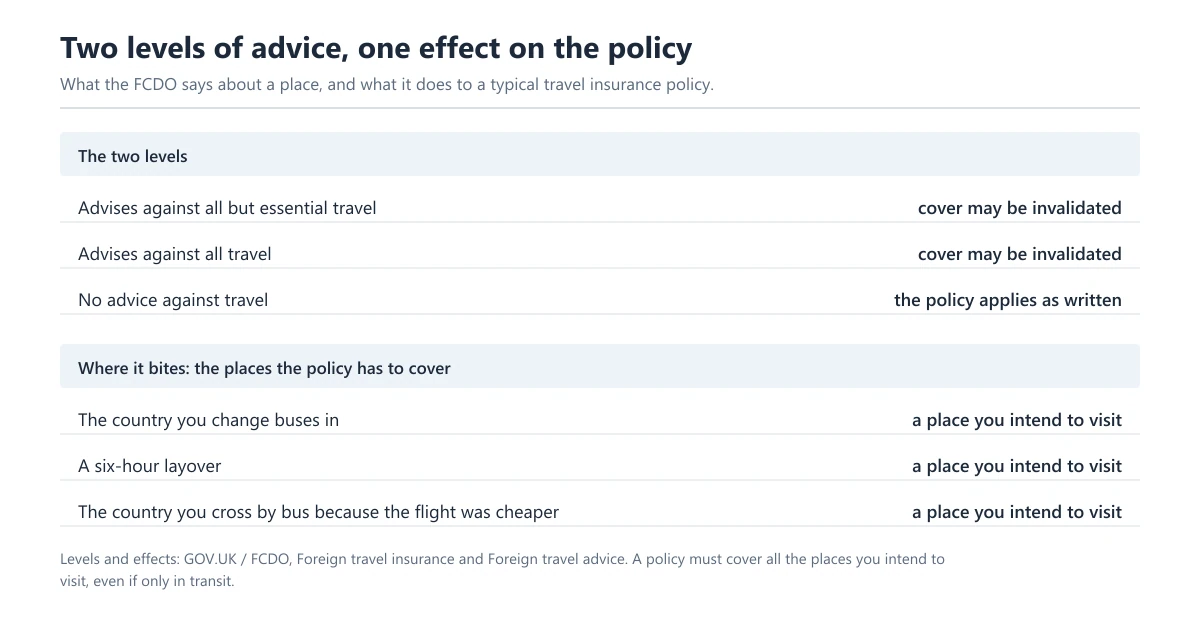
The FCDO does not write your policy. Your insurer does, and the insurer’s wording is where official advice becomes a condition of cover. GOV.UK’s guidance on exclusions is explicit about it: “many travel insurance policies will not cover travel to a high risk destination where the Foreign, Commonwealth & Development Office (FCDO) advises against […] travel”.
Two levels, then, and both of them can end your cover:
| What the FCDO says about the place | What it does to a typical policy |
|---|---|
| Advice level: all but essential travel | Cover may be invalidated. What counts as “essential” is the insurer’s call, not yours |
| Advice level: all travel | Cover may be invalidated. This is the stronger warning, and insurers treat it as such |
| No advice against travel | The policy applies as written — including the exclusions that our guide to backpacker exclusions sets out |
Note what the middle column does not say. It does not say your claim will be refused. It says it may be. That “may” is the whole problem: it turns a decision you make in a booking screen into a question an assessor answers months later, after the accident, with your policy wording in front of them and a medical report on the desk.
Where that leaves you depends on the rest of the wording. Our guide to travel insurance for backpackers covers the six exclusions that settle most claims; this article is about the exclusion that decides whether your policy applies at all.
Everything quoted above is the British version, because that is where the rule is published in these words. Readers outside the UK should find the equivalent their own government publishes — for Canadians, the travel advisories issued by the Government of Canada — and read their policy against that document rather than against the British one.
Why a route is riskier than a destination
Tourists pick one country. Backpackers string five together, and that changes the arithmetic. Our Southeast Asia backpacking route is built on land crossings between Vietnam, Cambodia, Thailand and Laos, and every one of those borders is a place your policy has to cover.
The gap is transit. Look at what the same guidance says a policy has to cover: “all the places you intend to visit, even if only in transit, in case anyone needs emergency treatment in a transit country”. A six-hour layover is a place you intend to visit. So is the country you cross by bus because the flight was cheaper.
Put those two paragraphs next to each other and the trap is obvious. You check the advice for Thailand, which is fine. You do not check it for the country you change buses in. Your insurance is written against a route, and you read it against a destination.
There is a second reason backpackers meet this rule more often than holidaymakers: long trips outlive their own research. Advice changes. A border closes, an election goes wrong, a regional advisory is added six weeks after you booked. Someone on a ten-day package is home before the page is updated. Someone on a nine-month trip is still there.
Which is why GOV.UK’s instruction is worth reading as a sequence rather than a checklist: “Check your policy wording and the relevant country travel advice pages before booking your trip and buying insurance”. Before booking. Not the week you fly, when the flights are paid for and the decision has quietly made itself.
What to do with this, in order
Find the country pages for your whole route, including the ones you only pass through. All of them. The transit country is the one people skip and the one the policy wording mentions by name. The destinations that score best in our budget comparison tend to be the ones where crossing by land is the ordinary way to move, which is exactly how a country ends up on your route without you deciding to go there.
Read the top of each page, not the whole page. The advice level is stated at the top. Everything below it is context for a decision you have already been told the answer to.
If the level is raised anywhere on your route, contact your insurer before you travel. Not after. The question to ask is narrow and answerable: does my policy still cover me in this country at this advice level? Get the answer in writing.
Subscribe to the email updates for every country on the route. It is free and it is the only way you will hear about a change while you are still able to do something about it.
Check the trip-length limit at the same time. The same guidance notes that a policy must cover “the full length of your trip”, and adds that “many policies have a maximum trip length and/or an annual limit on how much time in total you can spend outside the UK”. A nine-month route and an annual policy with a 60-day cap is a mismatch you want to find at the desk, not in a hospital.
None of this is a reason to avoid difficult places. It is a reason to know which difficulty you have bought, and which you have not.
Conclusion
The rule is short enough to memorise: the FCDO’s advice is not just information, it is a term of your contract.
That is an uncomfortable arrangement, because the two things are published by different organisations for different reasons, and nothing on the insurance page tells you to go and check the travel advice before you pay. But once you know it, the fix is cheap: five country pages, one email subscription, and a written answer from your insurer if any of those pages has a warning at the top.
Do that before you book, and the rest of your planning can be about the trip instead of about the paperwork.
About the author
The Shoestring Drift editors. Shoestring Drift is written and maintained by a small editorial team that builds travel guides around published prices and official sources rather than press trips or sponsored stays. Every figure we print carries the date we checked it and a link to where it came from, and we correct articles when a reader tells us a number has gone stale. If a rule in this guide no longer matches what your insurer told you, write to us and we will re-check it.
Sources cited
- GOV.UK / Foreign, Commonwealth & Development Office, Foreign travel insurance, last updated 2 August 2024 — https://www.gov.uk/guidance/foreign-travel-insurance
- GOV.UK / Foreign, Commonwealth & Development Office, Foreign travel advice — https://www.gov.uk/foreign-travel-advice
- Government of Canada, Travel advisories (the Canadian equivalent, for readers outside the UK) — https://travel.gc.ca/travelling/advisories


Related Posts