Travel Insurance Strikes: Who Pays When the Trip Breaks
Last updated: 28 September 2026. Figures checked against the sources listed at the end of this article.
Do not count on the airline. Do not count on the tour operator, the embassy, the insurance policy bought in a hurry, or the crowdfunding page a relative will start on your behalf.
Four of those five can help when a trip comes apart. Only one is contractually obliged to pay you, and that obligation lives in a document almost nobody reads for pleasure — a strange place to keep the only promise that matters.
That document names four ways a trip breaks: strikes and civil unrest, natural disasters, terrorist acts, and an airline or travel agent that stops trading. The UK’s Foreign, Commonwealth & Development Office lists all four inside its insurance guidance. What follows takes them one at a time, and every branch ends in the same place: who pays.
The four situations, and the list they sit in
GOV.UK’s guidance on foreign travel insurance keeps its exclusions in one section, and three of the four trip-breaking events are three consecutive bullets in it. The sentence above them is short: “Check how or whether an insurance policy covers:”. How, or whether — not “check that it covers”.
There is a second list on the same page, under a different instruction: “Check whether your policy covers:”. It runs to nine bullets. Seven are about health, evacuation or repatriation; the other two cover how long you are away and what you plan to do there. Not one of the nine is about a booking that collapses. The fourth trip-breaking event, the one about a business rather than a body, is not in the exclusions list: it sits under a third heading, “Check also whether:”.
That is how the document is built, and it explains the advice inside it: travel insurance guidance is written around a body that breaks, not a trip that breaks. When the trip is the thing that fails, your policy wording carries the answer, not the guidance. The exclusions that decide a claim when nothing breaks at all are a different list: our guide to the exclusions that catch backpackers works through those six.
The decision map: five branches, one answer each
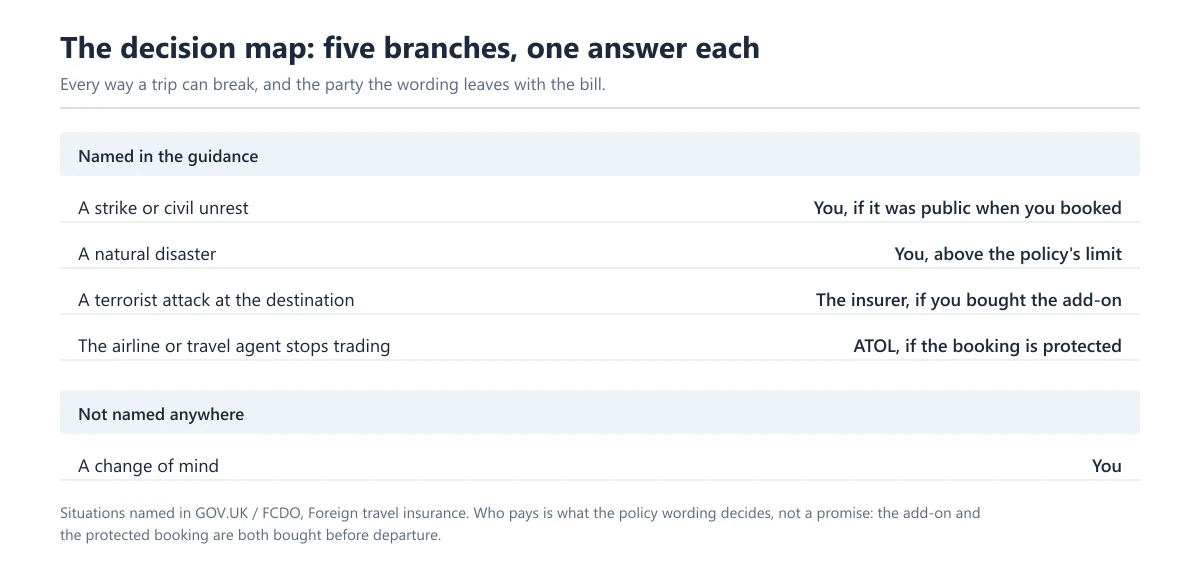
Read the table below as a map, not a set of verdicts: each row is a way a trip can break, what decides the money, and who pays. Every row can end with you paying, and two of them have a second answer — an add-on or a protected booking, both bought before departure. Neither can be arranged at claim time, so draw the map before you book.
| If the trip breaks like this | What decides the money | Who pays |
|---|---|---|
| A strike or civil unrest | Whether it was public when you booked, or when you bought the policy | You, if it was |
| A natural disaster | The limit written into your policy | You, above that limit |
| A terrorist attack at the destination | Whether the policy has the add-on | The insurer, if you bought it |
| The airline or travel agent stops trading | Whether the booking is protected | The protection scheme, or you |
| You no longer want to go | Nothing: it is not on any of the lists | You |
Branches one to three: the walkout, the earthquake, the attack
The walkout: what was public when you booked
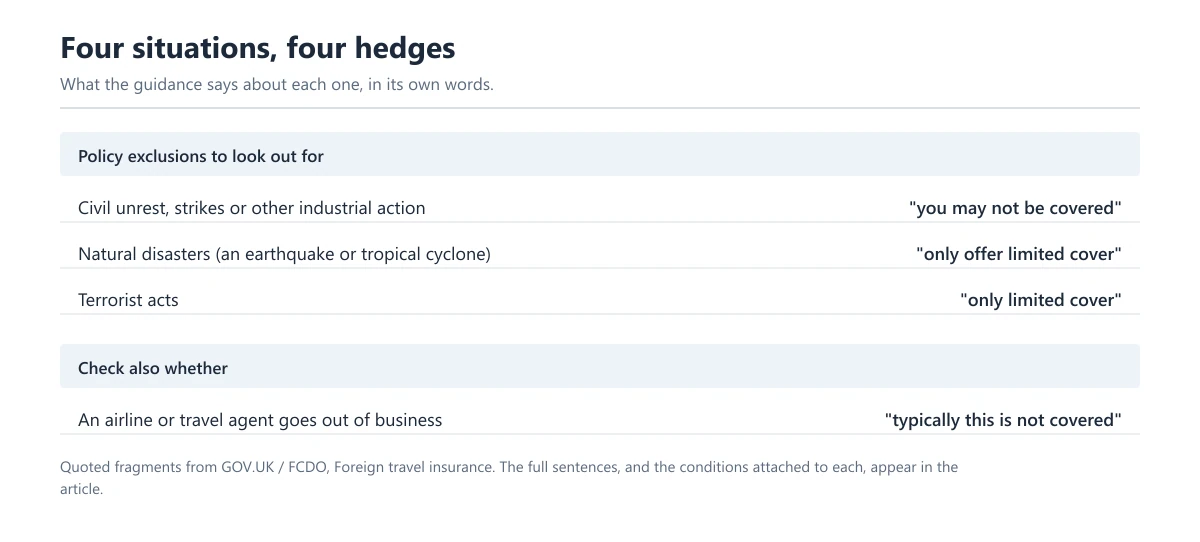
The bullet reads, in full: “civil unrest, strikes or other industrial action: you may not be covered for some claims that arise from these kinds of incidents, especially if they were known publicly when you booked your trip and/or bought your travel insurance policy”. That sentence contains two dates joined by a conjunction that does more work than either of them. It is not “when you booked and when you bought” — it is and/or, so an event that was public at either moment can land on your side of the line. That slash does more work than any other punctuation in the policy.
Read the same page’s instruction to buy cover early — “You should buy your travel insurance as soon as possible after booking your trip.” — and the two sentences stop reading as housekeeping and start reading as a way to close a window. Buy the policy while the news is quiet and neither date can help the other one. None of this overrides your wording: the guidance describes what insurers commonly do, and the bullet’s own verb is may.
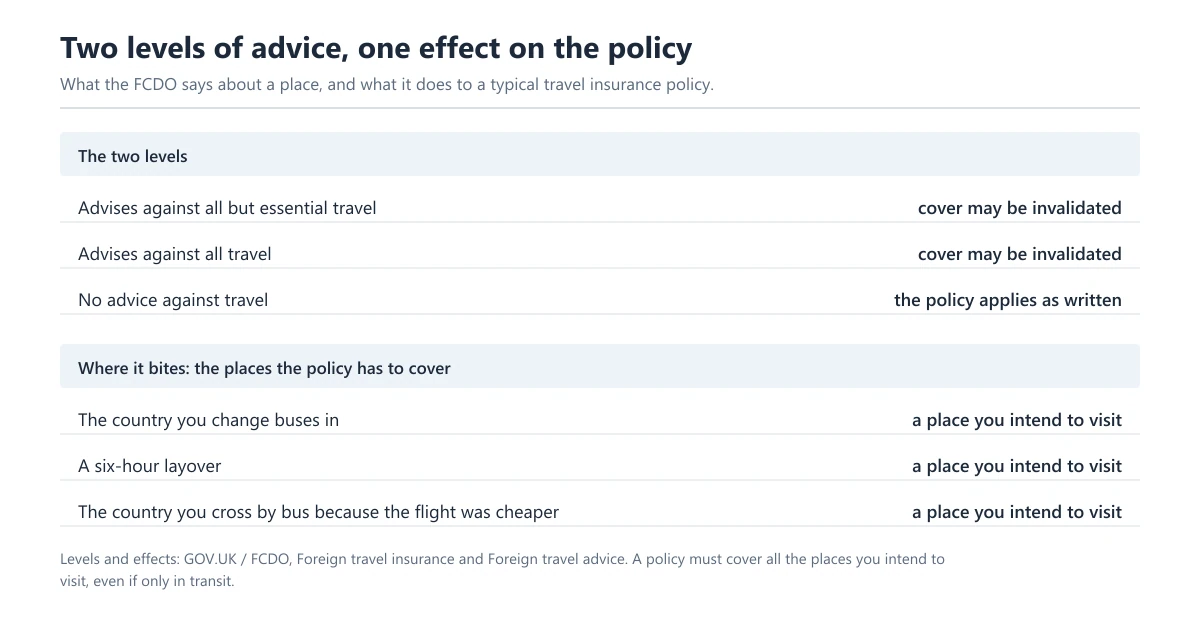
When unrest escalates instead of stopping, a second mechanism takes over: official advice for the country can be raised to a level that puts the policy itself in question. That rule comes from a different part of government. Check one of the two and skip the other and you are holding half an answer; when the official advice invalidates a policy is where the other half lives. Canada runs the same idea on a four-level scale, from “Take normal security precautions” to “Avoid all travel”, on its travel advisories pages.
Who pays: you, if the walkout was public when you booked the trip or when you bought the policy. If it was public at neither moment, the timing test settles nothing and the question moves to the cancellation section of the wording.
The earthquake: a limit, not a promise
The second bullet is shorter and vaguer: “natural disasters (such as an earthquake or tropical cyclone): some policies only offer limited cover for claims related to or caused by a natural disaster”. Three hedges in one sentence: some policies, not all; limited cover, not full; and a limit is a number. No published figure applies across the market, which is why this article prints none: the number you need is in your own document, and searching your wording for “disaster” beats reading the summary.
There is a timing difference the bullet does not spell out. A disaster that closes your route before you fly produces a cancellation; one that hits while you are there produces a decision, because staying and leaving are both open to you. That is a better question to put in writing than “are natural disasters covered?”.
Who pays: you, above whatever limit the policy sets.
The attack: the one bullet that mentions cancellation cover
The third bullet is the longest on the page, and the only one that uses the phrase this article turns on: “terrorist acts: most travel insurers offer only limited cover for terrorist acts but some offer policy add-ons to provide additional cover if there is a terrorist attack in your destination; this may include cancellation cover, if your destination is affected by a terrorist attack before your trip and you no longer wish to travel; as a minimum, make sure your policy covers you for emergency medical expenses and travel home if you are caught up in an attack”.
Notice where the cancellation cover sits: three conditions deep. Some insurers offer it, it arrives as an add-on, and it answers an attack before your trip that makes you decide not to travel. What survives once those conditions are stripped away is the floor the bullet names for itself, and that floor protects you from a bill rather than a decision.
Who pays: the insurer, for the medical floor, if you are caught up in an attack. You, for the change of mind, unless the add-on was already inside the policy.
Branches four and five: the company, and the change of mind
The company that stops trading
The fourth case is not in the exclusions list at all, and it is about a business rather than a destination: “the insurance policy provides cover if an airline or travel agent goes out of business – typically this is not covered. ATOL is a consumer protection scheme for air holidays and flights, managed by the Civil Aviation Authority (CAA). Choose an ATOL-protected holiday or a travel insurance policy that includes airline or supplier failure cover”.
That separate heading is the tell. Illness, theft and disaster are questions about your policy; a company collapsing is a question about your booking, so the guidance sends you elsewhere. The Civil Aviation Authority describes its own route as “Guidance on claiming a refund or a flight back home if a travel company goes out of business”, and names what funds it: “The ATT is the primary source of funding when an ATOL holder fails”.
ATOL is a British scheme, so if you are in Toronto or Melbourne you need whatever your own market publishes in its place. The question is the same in all four markets this site writes for: the check belongs at the booking, not the claim.
Who pays: the protection scheme standing behind the booking, if there is one. Otherwise you, unless the policy names supplier failure, and no wording can be amended to add it afterwards.
The trip you decide not to take
The fifth case has no bullet, which is why it belongs on the map. Nothing in the guidance covers a change of mind; the idea appears once on the whole page, as the third condition inside the terrorism add-on. A trip you abandon because you are frightened, short of money or no longer interested is not on any of the lists.
Who pays: you, unless the cancellation section of your wording names your reason. A change of mind is not a named reason in the guidance.
Before you book: what changes the branch
Three moves decide which of those five branches you end up in, and all three happen before you fly.
- Buy the policy in the same week as the booking. The strike bullet tests two dates, and the guidance says to buy “as soon as possible after booking your trip”. The shorter the gap, the fewer events can become public.
- Ask the narrow question, in writing, and keep the reply. Not “does the policy cover disruption?”, which invites a brochure answer, but “if a strike grounds a flight that has already been paid for, is that claim covered, and under which section?”.
- Check the booking, and leave part of the route unbooked. The supplier-failure route belongs to whoever takes the money, and a prepaid trip strands more money than a flexible one — the argument our Southeast Asia backpacking route makes from the other end.
- GOV.UK / Foreign, Commonwealth & Development Office, Foreign travel insurance, last updated 2 August 2024 — https://www.gov.uk/guidance/foreign-travel-insurance
- GOV.UK / Foreign, Commonwealth & Development Office, Foreign travel advice (the page where the advice level for a country is published) — https://www.gov.uk/foreign-travel-advice
- Government of Canada, Travel advice and advisories (the four-level scale, for readers outside the UK) — https://travel.gc.ca/travelling/advisories
- UK Civil Aviation Authority, ATOL protection — https://www.caa.co.uk/atol-protection/
- UK Civil Aviation Authority, Make an ATOL claim — https://www.caa.co.uk/atol-protection/consumers/make-an-atol-claim/
Conclusion
The map has five branches, and every one of them can end with you paying. Two offer a second answer — an add-on for the attack branch, a protected booking for the supplier branch — and both are bought at the booking stage, months before anyone knows whether they will be needed. You buy the answer before you know the question.
That is why you read four bullets on a government page before you pay for a flight: your wording decides which branch you are in, and the guidance only hands you the names to search for. If the document is silent about one of them, do not read that silence as cover. Ask in writing; if the answer is no, you have still learned which of the five you are relying on.
About the author
The Shoestring Drift editors. Shoestring Drift is written and maintained by a small editorial team that builds travel guides around published prices and official sources rather than press trips or sponsored stays. Every figure we print carries the date we checked it and a link to where it came from, and we correct articles when a reader tells us a number has gone stale. If a rule in this guide no longer matches what your insurer told you, write to us and we will re-check it.

Related Posts