Thailand Backpacking: The Real Fares

Prices checked: October 2026. Every price on this page was checked against the sources listed at the end. Where a figure could not be verified, this guide says so instead of guessing.
Last checked: 13 November 2026. Prices and rules change: the date each figure was read is inside the article.
Introduction
Here is the number nobody puts in a Thailand guide, because it is not a price. It is a date.
Day 31. Stay thirty days in Thailand on a visa exemption and you pay nothing for the permission. Stay thirty-one and a ฿1,900 charge appears at the immigration counter. That single line is bigger than everything else in this article’s “paid once” column put together — the Grand Palace at ฿500, Wat Pho at ฿300, the Khao Yai park fee at ฿400 and its vehicle charge at ฿30 — with ฿670 left over.
So this guide is built on a split, and then on a test.
The split: a trip’s money lives in two books that never mix. Book one is what you pay once per trip — entry, a monument, a park, a deposit. Book two is what you pay every day you are there — the bed, three meals, water, the ride across town. The test: close both books for a 14-day trip, a 30-day trip and a 60-day trip, and see which book moves.
Book one barely moves at all, and that is the point. At 14 days, the fixed costs in this article work out at ฿87.86 a day. At 30 days, the same bills spread over twice as many days: ฿41.00 a day. Then day 31 arrives with its ฿1,900, and the fixed book jumps to ฿100.97 a day — worse than the fortnight you were trying to beat.
To push it back below ฿41.00 a day you would have to stay until day 77. The standard permission — 30 days exempt, plus a 30-day extension, which is what the Canadian government describes as the maximum — stops at day 60, where the fixed book still costs ฿52.17 a day.
That is the whole argument of this article: in Thailand the length of your trip changes the price of your day more than the region you sleep in does. Everything below is the arithmetic behind that sentence, with the receipts.
How this guide prices things
Three rules, and they are the reason the numbers here look unlike the numbers in most Thailand guides.
Baht only. Nothing is converted to dollars, pounds, euros or Australian dollars. A conversion needs an exchange rate with its own date and its own source, and one invented rate would poison every figure downstream.
A published price, or a labelled gap. Four hostels publish their rates inside their own booking engines, so I could read real numbers for real dates. Where a price is not published anywhere I could reach — the train, the long-distance bus, the ferries — there is a hole in the table and the hole is named, rather than filled with something that sounds about right.
Prices belong to dates. The four bed prices quoted here were read on 4 October 2026 for the nights of 10 and 12 November 2026. That is what a bed costs for those two nights. It is not an average and it is not a promise about your week.
Book one: what you pay once per trip
These are the charges that do not repeat. You pay them once, or you pay them never.
| Item | Price | Who publishes it |
|---|---|---|
| 30-day visa-exempt entry | ฿0 | FCDO, entry requirements, current 4 Oct 2026 |
| Thailand Digital Arrival Card (TDAC) | ฿0 | Official TDAC site: “No Fees Required” |
| Extension of stay at Immigration | ฿1,900 per time | Samut Prakan Immigration, Thai Immigration Bureau |
| Re-entry permit, single | ฿1,000 | Samut Prakan Immigration |
| Re-entry permit, multiple | ฿3,800 | Samut Prakan Immigration |
| Grand Palace, Bangkok | ฿500 | Bureau of the Royal Household |
| Wat Pho, Bangkok | ฿300 | Wat Pho’s own site |
| Khao Yai National Park, foreign adult | ฿400 | Khao Yai National Park official site |
| Khao Yai vehicle fee, car | ฿30 | Khao Yai National Park official site |
| NapPark Hostel key-card deposit (refundable) | ฿400 | NapPark’s booking engine terms |
| Late checkout, one island hostel | ฿500 | Buddha View Hostel, Koh Tao |
Add the four non-refundable leisure items — Grand Palace, Wat Pho, Khao Yai entry and the car — and book one comes to ฿1,230. Add the extension and it becomes ฿3,130.
The line this table does not carry is the flight itself. How to price a cheap flight to Southeast Asia is the method for it: the baggage fee schedule, the moment of purchase that decides it, and the documents that decide both.
Two of those lines deserve a warning attached.
The ฿1,900 is not a fee you can dodge by leaving for a day and coming back for free. The FCDO’s reading of the current rules, updated for the change that took effect on 15 September 2026, is that a visa-exempt entry is “for tourism only”, lasts “up to 30 days”, and is “normally limited to two entries per calendar year”. Two entries do not add up to sixty days of freedom:
each one is its own 30 days, and the second one uses up your second entry for the year.
And the ฿400 at NapPark is the shape of a much bigger problem. The hostel’s own terms are blunt about how it takes money: “Full payment in cash plus deposit of 400 Baht per key card in cash are required upon check-in.” Cash only, at the counter, and “Rates do not include government tax.” A deposit is not a cost — you get it back — but it is cash you cannot spend while you hold the key card.
The rows I could not fill
There is no train fare in that table. There is no coach fare and no ferry fare in it either. Those are the three prices a Thailand budget actually turns on, and I could not read a single one from the operator’s own pages — the reasons are itemised at the foot of this article, in the section on what could not be verified.
What I can tell you is what the operators themselves say about the shape of those prices, and that is in the transport section below.
Book two: what you pay every day
Book two is where the days are. It starts with the bed, because the bed is the biggest single line of a backpacker’s day and the one price most guides refuse to pin down.
These four prices came out of the hostels’ own booking engines, for the same two nights — 10 to 12 November 2026 — read on 4 October 2026.
| Bed | Region | Published price for 2 nights | Per night |
|---|---|---|---|
| Pinto Hostel, 8-bed dorm, Ratchathewi, Bangkok | Bangkok | ฿860.00 | ฿430.00 |
| Pinto Hostel, 4-bed en-suite dorm | Bangkok | ฿1,000.00 | ฿500.00 |
| SHIN Hostel Changphuak, 10-bed mixed dorm, Chiang Mai | The north | ฿560.00 | ฿280.00 |
| SHIN Hostel Changphuak, 10-bed female dorm | The north | ฿560.00 | ฿280.00 |
| Buddha View Hostel, 10-bed mixed dorm, 300 m from Koh Tao pier | Island | ฿900.00 | ฿450.00 |
| Buddha View Hostel, capsule dorm with sunset balcony | Island | ฿1,000.00 | ฿500.00 |
| Buddha View Hostel, private 4-bed dorm | Island | ฿1,200.00 | ฿600.00 |
| Buddha View Hostel, private 6-bed dorm | Island | ฿1,100.00 | ฿550.00 |
| Lub d Koh Tao Tanote Bay, The Compact Hut | Island | — | ฿1,272 + tax |
| Lub d Koh Tao Tanote Bay, The Roomy | Island | — | ฿1,974 + tax |
| Lub d Koh Tao Tanote Bay, Tree Top Nest Seaview | Island | — | ฿3,027 + tax |
| SHIN Hostel, private room, shared bathroom | The north | ฿1,600.00 | ฿800.00 |
| SHIN Hostel, private room, en suite | The north | ฿2,800.00 | ฿1,400.00 |
| Buddha View, Mountain View Deluxe (private) | Island | ฿3,600.00 | ฿1,800.00 |
| Buddha View, Sunset Seaview Superior (private) | Island | ฿4,000.00 | ฿2,000.00 |
Read that table down the dorm column and something unexpected appears. The cheapest dorm bed of the three regions is in Chiang Mai, at ฿280 — not in Bangkok. The capital’s dorm is ฿430, which is 53.6% more than the north’s, and the island’s is ฿450. The famous cheap bed is not in the city everyone flies into.
Read the private-room rows instead and the map flips. A private room with a shared bathroom in Chiang Mai is ฿800. On Koh Tao the cheapest private room in this table is ฿1,800 — more than twice as much — and the top one is ฿2,000. On Koh Tao the jump from a dorm bed to a private room can be four times the price; in Chiang Mai it is under three.
And the last three Lub d rows show what happens when an island hostel decides to be a resort. Those three nightly rates — ฿1,272, ฿1,974 and ฿3,027, all “excl. taxes & fees” — are what the operator printed for one night in early October 2026. The tax is not small: on the ฿1,271.87 rate the engine added ฿237.84 of taxes and fees. A ฿1,272 hut is a ฿1,510 hut.
One more piece of small print worth copying down: Lub d’s own room list runs from ฿1,271 to ฿4,431 a night. That is one property, on one island, on one date.
What a day actually costs
Now the day itself. Four lines: bed, three meals, water, and getting around. Everything is per person, in baht, from a named source.
The food and transport figures come from Numbeo, which is user-contributed data and says so. Its Bangkok page was updated in October 2026 with 1,243 entries from 199 contributors in the previous twelve months; its Chiang Mai page the same month, with 784 entries from 66 contributors. These are survey figures reported by travellers and residents, not a published tariff, so treat them as a survey.
The day, in Bangkok
| Line | Floor | Typical | Source |
|---|---|---|---|
| Dorm bed | ฿430.00 | ฿430.00 | Pinto Hostel booking engine, 10–12 Nov 2026 |
| Three meals | ฿180.00 (3 × ฿60, bottom of the published range) | ฿300.00 (3 × ฿100) | Numbeo Bangkok, Oct 2026 |
| Water, two 1.5-litre bottles | ฿17.81 | ฿35.62 | Numbeo Bangkok |
| Two local journeys | ฿36.50 | ฿73.00 | Numbeo Bangkok |
| Day, no sightseeing | ฿664.31 | ฿838.62 | — |
| Grand Palace, once | ฿500.00 | ฿500.00 | Bureau of the Royal Household |
The day, in Chiang Mai
| Line | Floor | Typical | Source |
|---|---|---|---|
| Dorm bed | ฿280.00 | ฿280.00 | SHIN Hostel booking engine, 10–12 Nov 2026 |
| Three meals | ฿150.00 (3 × ฿50) | ฿217.50 (3 × ฿72.50) | Numbeo Chiang Mai, Oct 2026 |
| Water, two 1.5-litre bottles | ฿17.36 | ฿34.72 | Numbeo Chiang Mai |
| Two local journeys | ฿30.00 | ฿60.00 | Numbeo Chiang Mai |
| Day, no sightseeing | ฿477.36 | ฿592.22 | — |
| Khao Yai park fee, once | ฿400.00 | ฿400.00 | Khao Yai National Park |
A day in the north, at the same standard of eating and moving, is ฿246.40 cheaper than a day in Bangkok. Over a fortnight that difference alone is ฿3,449.60 — more than the hotel-and-temple fixed book of the whole trip.
The day on an island
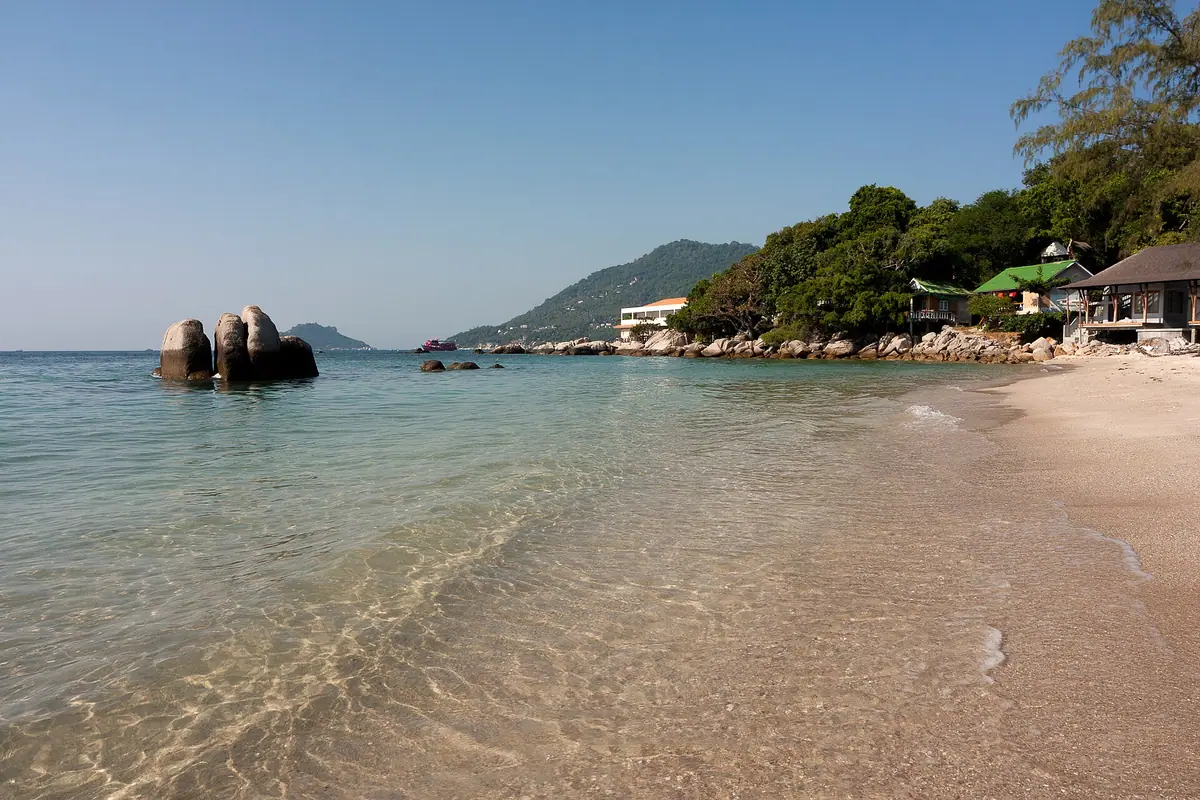
This is where this guide stops and puts its hands up. The bed is published — Buddha View’s 10-bed dorm, ฿450 a night for those two November nights. The rest of the day is not: no island page on Numbeo was read for this article, and neither the hostel nor the ferry operators publish what a plate of rice or a songthaew ride costs on Koh Tao.
So the island day is quoted as ฿450 for the bed, with food, water and local transport unpriced. If you insist on a working number, borrowing the mainland benchmark gives roughly ฿785.62 a day — but that figure is arithmetic on somebody else’s city, and it is labelled as such everywhere it appears.
What is genuinely island-specific and verifiable is the room, not the day: at the same hostel the private rooms are ฿1,800 and ฿2,000 a night, and at Lub d the huts start at ฿1,272 before tax. Island money goes into the walls, not the food.
The duration test: 14 days, 30 days, 60 days
Here is the test the whole article is built on. Two books, three trip lengths, same person, same habits.
Book one is the ฿1,230 of non-refundable one-off charges listed above (Grand Palace, Wat Pho, Khao Yai, park vehicle), plus the ฿1,900 extension when the trip needs one. Book two is the typical Chiang Mai day at ฿592.22, because it is the cheapest verified day in the article and it makes the maths honest rather than flattering.
| 14 days | 30 days | 31 days | 60 days | |
|---|---|---|---|---|
| Book one, total | ฿1,230 | ฿1,230 | ฿3,130 | ฿3,130 |
| Book one, per day | ฿87.86 | ฿41.00 | ฿100.97 | ฿52.17 |
| Book two, per day | ฿592.22 | ฿592.22 | ฿592.22 | ฿592.22 |
| Total | ฿9,521.08 | ฿18,996.60 | ฿21,488.82 | ฿38,663.20 |
| All-in, per day | ฿680.08 | ฿633.22 | ฿693.19 | ฿644.39 |
Three findings fall straight out of that table.
Doubling the trip from 14 to 30 days cuts the fixed cost per day by 53%. The ฿1,230 does not change. Only the denominator does.
One extra day, day 31, costs ฿1,900 and raises the daily fixed cost above the fortnight’s. It is the most expensive single decision in this entire budget, and it is caused by a date rather than by a purchase.
The recovery point is day 77. Divide ฿3,130 by 77 days and you get ฿40.65, the first figure below the ฿41.00 you were paying on day 30. But a 30-day exemption plus the 30-day extension the Canadian government describes as the standard maximum only reaches day 60 — ฿52.17 a day — and to go past that you need a visa obtained before you fly, as the FCDO’s own entry page says:
stay longer and “you must get the appropriate visa before you travel”.
There is a nastier comparison hiding in the same arithmetic. An overstay fine is ฿500 a day, capped at ฿20,000, per the FCDO. Four days of overstay — ฿2,000 — costs more than the ฿1,900 that buys thirty legal ones. And the cap arrives at day 40 of overstay, which is worth knowing precisely so that you never test it.
The number that should worry you most
Immigration may ask you to show funds. The FCDO prints the threshold: “at least 10,000 Thai baht per person or 20,000 Thai baht per family”, and adds that British nationals have been refused entry for failing to provide it.
฿10,000 is less than this article’s fortnight. The 14-day trip built from published prices above comes to ฿9,521.08 — under the threshold, which is a coincidence, not a margin — and the same fortnight spent in Bangkok comes to ฿12,970.68, which is over it. The proof-of-funds figure is a floor set for a different traveller than the one this site writes for. Do not read it as a budget.
Where the money goes without asking you
Every country has a handful of specific leaks, and Thailand’s are unusually well documented by other governments. Here are the ones with a number or an official warning attached.
The arrival card that charges you for being free. The official Thailand Digital Arrival Card is free — the site’s own headline is “Official Thailand Digital Arrival Card (TDAC) – No Fees Required”. On 17 October 2025 the Ministry of Tourism and Sports published a warning titled “Tourism Ministry warns of fake TDAC websites charging fees; registration remains free.” If a page asks for a card fee, it is not the government.
The passport left behind as a guarantee. The FCDO is unusually direct: “Do not hand your passport over as a guarantee, for example to motorcycle or jet-ski rental businesses.” The Canadian government describes why: “Rental companies have at times accused renters of causing damage upon return of the equipment”, and in some cases renters who refused to pay “were harassed and threatened, and their passports (left as collateral) were withheld”.
The gems. Canada’s advisory documents the shape of it: merchants “sell lower-quality items at inflated prices with promises that the items can be resold at a profit”, and the guarantees are not always honoured. The same page notes the Canadian government cannot help you get the money back.
The bar tab. “Some bars, nightclubs and entertainment venues may try to charge exorbitant prices”, Canada warns, and adds that arguments about overcharging “may lead to threats of violence”. The advice is to confirm prices before you consume and not to run a tab.
The card in the machine. The FCDO reports “incidents of ATM skimming” and tells travellers to “use an ATM in a bank and always protect your PIN”. What a Thai bank charges a foreign card for a withdrawal is not something this article can tell you — no bank fee schedule was readable — so that line is a hole, not a number.
The bag under the coach. Canada: “Thefts occur on cross-country buses and vans. Personal belongings, including passports, have been stolen from luggage compartments under buses, especially on long-distance journeys.” The same advisory warns that break-ins happen at budget guesthouses “sometimes while guests are asleep in their rooms”.
The drink. The FCDO records deaths and serious illness from methanol in alcoholic drinks in Thailand, notes that it cannot be detected by taste or smell, and warns about drink spiking in tourist areas. Its advice on drinks served in bars is worth repeating: they are often stronger than what you are used to.
The cigarette in the street. Fines for smoking in public run up to ฿5,000. Vapes are a different order of problem: possession or use can lead to confiscation, fines “typically 5,000–30,000 Thai bhat”, detention and court proceedings, with no exception for tourists or personal use. A drone you did not register with the NBTC is ฿100,000 or five years, or both. Carrying more than 120 playing cards is an offence under a 1943 Act.
The last drink of the night. Alcohol sales are restricted between midnight and 11am, per the FCDO, and the exemption covers licensed hotels, international airport terminals and authorised entertainment venues. Practically: the shop that sells you a ฿60.48 bottle of beer in Bangkok stops at midnight, and after that the same beer is a bar beer at ฿90.
Safety, area by area
Generic advice is useless here, because Thailand’s risk map is not uniform. Both governments publish lines, and they are specific.
The four southernmost provinces. The FCDO advises against all but essential travel to parts of Thailand, and those parts are the four provinces at the southern tip by the Malaysian border, where it records regular attacks and martial law in most areas. The Canadian government names them: Narathiwat, Pattani, Yala, and southern Songkhla province including Hat Yai city and the area east of Highways 408 and 4113 — “Avoid all travel”.
The Cambodian border. Canada’s advisory is “Avoid all travel to the area within 50 kilometres of the Thailand-Cambodia border”, and notes that “Land border crossings between Thailand and Cambodia are currently closed.” That is worth knowing before you plan a visa run on land.
The Myanmar border. High degree of caution in the Thailand-Myanmar border areas of Mae Hong Son and Tak provinces; border crossing points may close without notice.
Bangkok, the demonstrations. Canada lists the recurring sites — the area around Victory Monument, Thammasat University, the Bangkok Arts and Cultural Centre, the Democracy Monument, Ratchaprasong intersection — and warns that even peaceful demonstrations can turn violent and can close mass-transit stations.
The islands and the parties. Canada is specific about the riskiest nights of the Thai calendar: be careful at night in entertainment areas throughout the country, “including in Koh Pha Ngan and Koh Tao, particularly during full moon parties, Songkran, and other events”, where robberies and assaults, including sexual assaults, can occur and where “passport thefts and losses are common”. Thailand legalised same-sex marriage in January 2025 and the FCDO describes the country as generally safe for LGBT+ travellers.
The general level. Canada’s overall rating for Thailand is “Exercise a high degree of caution”, driven by political tensions and sporadic demonstrations.
The numbers to have in your phone. Police 191, tourist police 1155, medical assistance 1669, firefighters 199. The Tourism Authority of Thailand runs a hotline on 1672 — press 9 for English. Canada’s advisory adds one instruction that matters for insurance later: report any criminal incident to the Thai police in the jurisdiction where it happened, before you leave the country.
Taxis: the official meter, and how it gets bent
Thailand’s Ministry of Transport publishes the meter. This is the official tariff for a taxi of up to seven seats registered in Bangkok, in force since 13 January 2023, when the flag fall went from ฿35 to ฿40:
| The meter | Rate |
|---|---|
| First kilometre | ฿40.00 |
| 1–10 km | ฿6.50 per km |
| 10–20 km | ฿7.00 per km |
| 20–40 km | ฿8.00 per km |
| 40–60 km | ฿8.50 per km |
| 60–80 km | ฿9.00 per km |
| 80 km and over | ฿10.50 per km |
| Stuck in traffic, under 6 km/h | ฿3.00 per minute |
| Booked through a call centre or an app | +฿20.00 |
| Collected from the official queue at Don Mueang or Suvarnabhumi | +฿50.00 |
Nobody publishes the distance from Suvarnabhumi to Khao San Road, so here is the government’s own arithmetic on an example distance of 10 kilometres — an illustration, not a measurement: ฿40 for the first kilometre, then nine kilometres at ฿6.50, which is ฿58.50, for ฿98.50, plus the ฿50 airport queue charge, plus whatever expressway tolls the driver takes. Traffic minutes are on top, at ฿3 each.
Three things break that arithmetic in practice, and all three are documented.
The first is the queue itself. Canada’s advice when you land is to use “the airport rail-link service or official airport buses”, or a hotel shuttle or a trusted ride-hailing app, and it warns that “unlicensed vehicles (bearing black and white licence plates) are not correctly insured to carry passengers and may not use meters”.
The second is the argument at the end. Canada: “Disputes with taxis operators, tuk-tuks (motorized rickshaws), etc., occur and have occasionally resulted in violence or intimidation”, and if you feel threatened you should ask the local police to settle it rather than settle it yourself.
The third is not a scam but a data problem, and it is a good example of why this site prints sources. Numbeo’s Bangkok page still lists the taxi flag fall at ฿35, with a range of ฿35 to ฿45. The official tariff has said ฿40 since January 2023. The crowd-sourced number is stale, and it is the number most guides quote.
Getting around a city
This is the section where the operators of Thailand’s urban networks defeat a text-based reader, and I am going to say so rather than guess.
The MRT (Blue Line) publishes its fares only as a picture. The Mass Rapid Transit Authority’s English and Thai fare pages carry a station-pair matrix as an image, split by passenger type — general, elderly, students — plus links to a fare calculator and to the royal-gazette fare regulations. I downloaded the general-public matrix for the Blue Line and read it: the top fare on the board is ฿45, and the cheapest central hops sit in the high teens.
Treat the ceiling as solid and the floor as approximate, because no text version of that table exists to check it against.
The BTS publishes no tariff text at all. Its Routes and Fares page is a journey planner with an origin and destination selector and a route-map image. The obvious URL for a fare table returns a 404. So the Skytrain’s price range is a hole in this article.
The buses and the river boats are the same story. The Bangkok Mass Transit Authority’s site renders client-side and came back empty, and the Chao Phraya Express Boat’s site did the same. Two of the cheapest ways to cross Bangkok are unpriced here for one reason: their operators do not serve prices as text.
What is left is the survey data, and it is useful even where it is imprecise.
| Local transport | Bangkok | Chiang Mai |
|---|---|---|
| One-way local ticket | ฿36.50 (range ฿25–฿61) | ฿30.00 (range ฿30–฿40) |
| Monthly pass, normal price | ฿1,177.50 | ฿1,800.00 |
| Taxi, flag fall as surveyed | ฿35.00 | ฿40.00 |
| Taxi, 1 km | ฿40.00 | ฿18.50 |
| Taxi, one hour of waiting | ฿200.00 | ฿80.00 |
| Petrol, 1 litre | ฿47.29 | ฿49.36 |
| Monthly mobile plan, calls + 10 GB+ | ฿500.38 | ฿414.00 |
| Cinema ticket | ฿255.00 | ฿220.00 |
Two contradictions are visible in that table if you have read the taxi section above. Numbeo puts Bangkok’s flag fall at ฿35 when the meter says ฿40, and it puts a one-kilometre taxi ride at ฿40 — which is the flag fall, not the flag fall plus a kilometre. And Chiang Mai’s monthly pass is ฿622.50 more expensive than Bangkok’s, which is the opposite of what most travellers expect from the cheaper city.
For the day budget in this article I used the one-way ticket, twice: ฿73.00 in Bangkok and ฿60.00 in Chiang Mai. That is a commuter’s day, not a sightseer’s day — the day you go to Ayutthaya, the number changes completely.
Trains, coaches and ferries: what the operators publish
Thailand’s intercity network is where a budget either holds or breaks, and it is the biggest gap in this article. Here is exactly what the operators do publish, and what they do not.
The train. The State Railway of Thailand sells online through its own D-Ticket system, and its booking terms list which services can be booked that way: special express, special express diesel railcar, special express CNR, rapid trains and tourist trains are bookable, while ordinary, suburban and local trains are not. Reservations open up to 180 days ahead and must be made at least three hours before departure.
That is a real, checkable set of rules about how to buy the ticket.
What the SRT does not give me is a price I can read. Its website timed out repeatedly across several attempts, including on the fare-regulation and guidebook PDFs, and every other route to a current fare table failed as well. Two things are documented about the direction of fares, and they point the same way.
In March 2026 Thairath’s government-policy desk reported that the Department of Rail Transport was preparing to announce new fare and freight rate ceilings, in the middle of a fuel crisis in which the railway burns 8 to 9 million litres of diesel a month — about ฿270 million. In April 2026 the operator’s acting governor Anan Phonimdang said the opposite of a fare rise:
“The SRT’s budget was based on a diesel price of 35 THB per liter, but current prices have risen to 50–60 THB per liter, increasing variable operating expenses by 30%”, against a daily consumption of 220,000 litres — and that the railway would ask for a subsidy rather than raise fares.
So: the fares are, as of the last published statement, unchanged; a new ceiling is being prepared; and the number itself is a hole in this guide. If you are booking the Bangkok–Chiang Mai sleeper, buy it on the operator’s own system and treat any blog fare you read as a claim, not a fact.
The coach. The Transport Co. Ltd — the state bus company known as บขส — publishes its announcements online, and one of them, dated 14 September 2026, is titled a notice of the use of new fare rates. That page would not load for me, and neither would the company’s English fare pages. Another hole, in the same place.
The ferry. Lomprayah High Speed Ferries is the operator most backpackers end up using between the Gulf islands, and its own site is generous about everything except money. It publishes its routes, its fleet, and its timings: high-speed catamaran crossings of roughly 45 to 90 minutes, vehicle ferries at 90 to 120 minutes, and departures from Bangkok (Khao San) at 06:00 to Koh Tao, Koh Phangan and Koh Samui. There is no fare table on the page.
Prices live inside the booking engine, behind a date and a passenger count.
What that means for book two is simple and annoying: the single biggest line of a two-week island trip is the one line no operator publishes where a reader can check it. Budget for it, and treat every estimate you find — including any that might have appeared here — as an estimate.
Where to eat, from cheapest to dearest

This ladder runs from the cheapest published figure in Thailand to the most expensive one, and every rung is a number somebody published, not a range somebody remembered.
Rung one, the bottom of the market. Numbeo’s published range for an inexpensive meal starts at ฿60 in Bangkok and ฿50 in Chiang Mai. That is the floor: at the range’s midpoint you are paying ฿100 and ฿72.50 respectively.
Rung two, the supermarket. Eight items in Bangkok come to a specific, checkable total — bread 500 g ฿49.73, rice 1 kg ฿46.74, a dozen eggs ฿86.31, chicken fillets 1 kg ฿121.00, tomatoes 1 kg ฿64.86, onions 1 kg ฿51.33, bananas 1 kg ฿59.80 and 1.5 litres of water ฿17.81. That is ฿497.58, and it is very slightly less than five plates at the ฿100 midpoint. Cook it yourself and the only thing you save is the walk.
In Chiang Mai the same eight lines cost ฿398.71 — bread ฿47.92, rice ฿44.45, eggs ฿75.30, chicken ฿93.33, tomatoes ฿49.74, onions ฿36.55, bananas ฿34.06, water ฿17.36. That is ฿98.87 less than Bangkok for identical shopping, and it is about five and a half ฿72.50 plates.
Rung three, the neighbourhood restaurant. The place where the people who live there eat is what Numbeo’s “inexpensive restaurant meal” is measuring: ฿100 in Bangkok, ฿72.50 in Chiang Mai. The published range around that midpoint is wide — ฿60 to ฿250 in Bangkok, ฿50 to ฿150 in Chiang Mai — and the width is the point. A 250-baht plate in Bangkok is not a scam; it is the top of the ordinary band.
Rung four, the known quantity. A McDonald’s combo is ฿235 in Bangkok and ฿185 in Chiang Mai. Worth knowing, because it is the one meal whose price you already understand before you land, and it costs more than twice the cheap plate.
Rung five, the treat. A three-course meal for two at a mid-range restaurant: ฿1,200 in Bangkok, on a published range of ฿700 to ฿3,000, and ฿650 in Chiang Mai on a range of ฿450 to ฿1,337.25. Two people, in the north, can eat properly for what one person spends on two days of dorm beds.
Rung six, the ceiling. The top of Numbeo’s published band: ฿3,000 for two in Bangkok. That is six and a half nights in the SHIN dorm.
Drinks, in the same currency. The same 0.5-litre local beer costs ฿90 at a bar in Bangkok and ฿60.48 from a shop — a ฿29.52 difference on one bottle. In Chiang Mai it is ฿80 at a bar against ฿53.60 from a shop, a ฿26.40 gap. Imported beer runs ฿150 in Bangkok and ฿127.50 in Chiang Mai for a 0.33-litre bottle, which is 2.5 times the price of the local bottle from a shop.
Water, at three prices. A 0.33-litre bottle is ฿11.86 in Bangkok — that is ฿35.94 a litre. A 1.5-litre bottle is ฿17.81, which is ฿11.87 a litre. Same product, three times the price per litre, and the small bottle is the one sold at the temple gate. In Chiang Mai: ฿33.58 a litre for the small bottle against ฿11.57 for the big one.
Two honest gaps sit under this ladder. No published source I read states when Thais actually eat, and no source I read gives a tipping norm in baht, so this article has neither. What is documented is narrower and more useful: alcohol sales stop at midnight outside licensed venues, and the Grand Palace sells tickets only between 8:30 and 15:30 — so the day’s real constraint in Bangkok is not lunch, it is the ticket window.
Both of those gaps are filled, with sources, in our guide to eating, drinking and staying safe in Thailand, which also prices the night out area by area.
Nightlife, parties and the calendar
A night out in Thailand has two prices, and the gap between them is the cheapest money you will ever save.
The beer. Bar prices and shop prices are published, and they are the same beer: ฿90 against ฿60.48 in Bangkok, ฿80 against ฿53.60 in Chiang Mai. Imported bottles cost ฿150 and ฿127.50; wine is ฿500 for a mid-range bottle in Bangkok and ฿599.50 in Chiang Mai, which is one of the few lines where the north is dearer.
The deadline. Alcohol sales are restricted from midnight to 11am. The practical result is that a night out has a shop phase and a bar phase, and the shop phase ends at midnight.
The law. The legal drinking age is 20, per the Canadian advisory. Fines for smoking in public run to ฿5,000. Vapes are illegal to possess or use, with fines typically ฿5,000 to ฿30,000.
A quieter night, priced. A cinema ticket is ฿255 in Bangkok and ฿220 in Chiang Mai. A month’s gym membership is ฿1,966.67 and ฿1,262.38. Both are cheaper than a serious bar tab and both are published.
The dates. Songkran, the Thai New Year, is in mid-April — Canada’s advisory flags it, along with 1 January, as a period when drunk driving and accidents become “much more frequent”, and describes it as one of the events when assaults and passport thefts cluster in tourist areas. Full moon parties are named in the same warning, specifically around Koh Pha Ngan and Koh Tao.
I could not verify the dates of Loi Krathong, the lantern festival, from any official source read for this article, nor the price of a full moon party ticket, so neither appears here as a number.
Getting home. After midnight, the meter is the honest option: flag fall ฿40, the first ten kilometres at ฿6.50, ฿3.00 a minute in traffic, plus ฿20 if you booked it through an app. Canada’s advice is to pre-arrange your transport home so you never accept a lift in an unlicensed vehicle — and on the islands, where the party is, that advice is doing real work.
Renting a car or a scooter — and whether you need to
Start with the answer, because the data supports it: for the route this guide prices, you do not need a vehicle. Bangkok’s day costs ฿73.00 in local transport, the north’s ฿60.00, and both are served by operators who sell tickets at counters. A rental adds a deposit, a licence problem and a liability, and buys you very little on an itinerary that runs city–city–island.
If you rent anyway, three things are documented and none of them are optional.
The paperwork. The FCDO’s line for British licence holders is that you need to carry both the 1968 version of the international driving permit and your driving licence. It adds that you cannot buy an IDP outside the UK, so it has to be sorted before you fly. The Canadian advisory says the same in its own words:
you must carry an IDP or a Thai licence, and “it is illegal to operate a motorcycle without a valid Thai motorcycle licence or an international driving permit with a motorcycle endorsement”.
The insurance. The FCDO’s warning is the one that costs money: “If you drive a car or ride a motorcycle in Thailand without a valid licence, it could invalidate your travel insurance and you’ll be unable to claim if you have an accident or injury.” Canada goes further and says plainly: “Avoid driving or riding motorcycles in Thailand, even if you are an experienced motorcyclist.”
The vehicle itself. The FCDO reports that “motorcycles and scooters for hire in tourist areas are often unregistered and cannot be used legally on a public road”. Helmets are mandatory for riders and passengers — and Canada notes many helmets sold and lent there do not meet international safety standards.
Then the trap that has nothing to do with driving. Both governments describe rental businesses that keep the passport as security and later claim damage — Canada’s line about renters being accused of damage, harassed and having passports withheld is quoted in full above. The FCDO’s instruction is a single sentence: do not hand the passport over.
What I cannot give you is the price. No rental rate, deposit or young-driver surcharge for Thailand could be read from any operator’s page for this article — the rates sit behind quote engines. The ฿400 key-card deposit at NapPark is not a car deposit, but it is a useful reminder of the shape of the thing:
in Thailand, deposits are paid in cash and returned in cash, and the conversation about whether anything was damaged happens at the counter, not by email.
What this adds up to: a fortnight and a month
Two itineraries, built only from the prices in this article, for one person. Both exclude the flight and exclude the intercity tickets, which nobody publishes in a form I could read — so treat these as the cost of being in Thailand, not the cost of getting around it.
A fortnight: five nights in Bangkok, five in Chiang Mai, four on Koh Tao.
| Nights | Per day | Total | |
|---|---|---|---|
| Bangkok | 5 | ฿838.62 | ฿4,193.10 |
| Chiang Mai | 5 | ฿592.22 | ฿2,961.10 |
| Koh Tao (bed published; food and water at the mainland benchmark) | 4 | ฿785.62 | ฿3,142.48 |
| Book one — Grand Palace, Wat Pho, Khao Yai, park vehicle | — | — | ฿1,230.00 |
| Total, 14 days | ฿11,526.68 | ||
| Per day | ฿823.33 |
A month in the north, which is the cheapest verified day in this article.
| Days | Per day | Total | |
|---|---|---|---|
| Chiang Mai | 30 | ฿592.22 | ฿17,766.60 |
| Book one | — | — | ฿1,230.00 |
| Total, 30 days | ฿18,996.60 | ||
| Per day | ฿633.22 |
Look at the two per-day figures side by side: ฿823.33 for the mixed fortnight against ฿633.22 for the month in one city. The month is ฿190.11 a day cheaper — 23% less — and it is not because Chiang Mai is cheap. It is because the fixed book got a bigger denominator.
That is the finding this article was built to test, and it holds in both directions. A fourteen-day trip that moves every few days pays for its own movement twice: once in the daily book, where a Bangkok day costs ฿246.40 more than a Chiang Mai day, and once in the fixed book, where the same ฿1,230 is divided by fourteen instead of thirty.
And it breaks in exactly one place, which is the reason the article opens where it does: the ฿1,900. Stay twenty-nine days and the arithmetic rewards you. Stay thirty-one and a single counter transaction undoes a month of discipline.
Vietnam is the next country on almost every Southeast Asian route, and the Vietnam guide prices the trains and the sleeper buses leg by leg.
Indonesia is the other half of the Southeast Asian island route, and the Indonesia guide prices the ferries between the islands rather than the flight in.
What we could not verify
This is the section that matters more than the ones above it, so it is not buried.
Every train fare. The State Railway of Thailand’s own site timed out on every attempt, including its fare-regulation and guidebook PDFs, and no alternative route to a current fare table worked. What this article can state is the booking rules and the operator’s own public position on fares — not a price.
Every long-distance coach fare. The Transport Co. Ltd’s notice of new fares, dated 14 September 2026, would not load, and neither did its English fare pages.
Every ferry fare. Lomprayah publishes routes, fleet and journey times, and no prices outside its booking engine. Koh Tao, Koh Samui and Koh Phangan are unpriced here as a result.
BTS fares. The Skytrain publishes no text tariff; its Routes and Fares page is a journey planner, and the obvious fare URL returns 404.
MRT fares as text. The Blue Line matrix exists only as an image. I read ฿45 as the top general-public fare from the published image; the lowest cells sit in the high teens, and I would not defend a precise floor.
The Airport Rail Link fare. The domain that looked most promising belongs to the Red Line operator, and no ARL page was reachable.
River boat and city bus fares. Both operators’ pages render client-side and returned empty bodies.
The ATM fee charged to a foreign card. No Thai bank fee schedule was readable.
Temple and park fees beyond the four confirmed. Wat Arun’s official site is defunct and appears compromised; the Tourism Authority’s attraction pages are behind a bot challenge; and the Department of National Parks’ hosts returned a 503, an empty body and a refused connection across several attempts. Doi Inthanon, Erawan, Phi Phi, Ayutthaya, Doi Suthep and Wat Chedi Luang are therefore unpriced here. The ฿400 and ฿200 I do quote are Khao Yai’s, from the park’s own site.
A dorm rate inside Khao San Road itself. NapPark publishes its rooms, its policies and its ฿400 key-card deposit, but no rate: the price sits behind the booking engine. The three dorm prices in this article come from Ratchathewi in Bangkok, Chang Phuak in Chiang Mai and the pier road on Koh Tao.
Car and scooter rental rates, deposits and surcharges. Behind quote engines, all of them.
Tipping, Thai meal times, Loi Krathong dates, full-moon-party ticket prices, island food and transport prices. No published source was found for any of these, so none of them is stated as a figure.
Conclusion
Thailand is not a cheap country or an expensive one. It is a country with two books, and the difference between a ฿600 day and an ฿850 day is mostly about which book you are reading.
Book two — the bed, three meals, water, the ride across town — is where the region decides your price. A dorm bed is ฿280 in Chiang Mai, ฿430 in Bangkok and ฿450 on Koh Tao, and a full day of eating cheaply and moving around lands at ฿592.22 in the north against ฿838.62 in the capital. If you want to spend less, move north; that is the honest lever, and it is worth ฿246.40 a day.
Book one — the entry, the temples, the park — is where the calendar decides it. ฿1,230 of one-off charges costs ฿87.86 a day on a fortnight and ฿41.00 a day on a month.
Then day 31 arrives with ฿1,900 attached, which is more than the Grand Palace, Wat Pho, the Khao Yai fee and the car fee put together, and which you cannot pay your way out of by staying longer until day 77 — a day the standard permission does not reach.
So the plan writes itself, with numbers instead of adjectives. Stay thirty days rather than fourteen, because the fixed book halves. Stay out of the capital when you can, because the daily book is 41.6% higher there. Take the dorm, because the island private room is where the money actually disappears — ฿1,800 against ฿280 for the same night’s sleep in a different postcode.
And before you extend anything, remember that four days of overstaying costs ฿2,000, which is more than thirty legal days cost.
Before you book a bed on price alone, read how to judge a bed before you book it; if you are costing a longer trip across several countries, the method is in how much backpacking actually costs, and the route this budget is built on is drawn in the Southeast Asia backpacking route.
If you are carrying on through the region, Malaysia, priced the same way does the same arithmetic for the other side of the peninsula.
Going the other way, Cambodia and Laos are the two land borders that follow this one.
About the author
John Q. Shoestring Drift builds its guides from published prices and official documents rather than press trips, and nobody here has taken the trip this article describes. Our figures came from two UK Foreign Office pages, the Canadian government’s travel advisory, two Thai government portals, an immigration office’s fee schedule, the official arrival-card site, the Thai Ministry of Tourism and Sports, the Bureau of the Royal Household, Wat Pho, Khao Yai National Park, two Numbeo city pages, four hostels’ own booking engines, a hostel’s booking terms, the State Railway of Thailand’s booking conditions, two Thai news reports on the railway’s finances, a ferry operator and the Bangkok metro authority. If a price stops matching what you pay, write to us and we will re-check it.
John Q writes and checks every guide on this site. More about the author.
Sources cited
- GOV.UK / FCDO, Thailand travel advice: Entry requirements — visa exemption of 30 days for tourism from 15 September 2026, two entries per calendar year, passport validity, proof of funds of ฿10,000/฿20,000, overstay fine of ฿500 a day to ฿20,000, digital arrival card — read 4 October 2026 — https://www.gov.uk/foreign-travel-advice/thailand/entry-requirements
- GOV.UK / FCDO, Thailand travel advice: Safety and security — passports as rental collateral, methanol poisoning, ATM skimming, alcohol sale hours, smoking and vaping fines, drone registration, driving and the 1968 IDP, road and sea travel, rainy season — read 4 October 2026 — https://www.gov.uk/foreign-travel-advice/thailand/safety-and-security
- Government of Canada, Thailand travel advice and advisories — last updated 22 September 2026 — 30-day visa exemption extendable for up to 30 days, METV and DTV, regional advisories including the 50 km Cambodian border zone and the four southern provinces, gem and rental scams, bus luggage theft, bar overcharging, alcohol age 20, emergency numbers — https://travel.gc.ca/destinations/thailand
- thailand.go.th (Government Public Relations Department), Countries/Territories entitled for visa exemption for a visit of not exceeding 30 days — source credited to the Department of Consular Affairs — 30 days, twice per calendar year, proof of funds of ฿10,000 per person or ฿20,000 per family — https://thailand.go.th/issue-focus-detail/001-01-022?hl=en
- thailand.go.th (Government Public Relations Department), Bangkok taxis increase fares — created 14 March 2023, updated 12 July 2023 — the official meter tariff in force since 13 January 2023, the ฿20 booking charge and the ฿50 airport queue charge — https://thailand.go.th/public/issue-focus-detail/001_08_001?hl=en
- Samut Prakan Immigration (Immigration Bureau, Royal Thai Police), Immigration Fees — extension of temporary stay ฿1,900 per time, re-entry permits ฿1,000 and ฿3,800, tourist visa ฿1,000; ministerial order 27 (2003), published in the Royal Gazette vol. 120 part 59a on 27 June 2003 — https://www.samutprakanimmigration.go.th/immigration-fees/
- Thailand Digital Arrival Card, official site — “Official Thailand Digital Arrival Card (TDAC) – No Fees Required” — https://tdac.immigration.go.th/
- Ministry of Tourism and Sports of Thailand, Tourism Ministry warns of fake TDAC websites charging fees; registration remains free — published 17 October 2025 — https://www.mots.go.th/mots_en/news/3764
- The Grand Palace, Bureau of the Royal Household — “Tickets sold from 8:30 AM – 3:30 PM and cost 500 baht”; open daily 8:30–16:30 — https://www.royalgrandpalace.th/en/home
- Wat Pho (Wat Phra Chetuphon Wimon Mangkhalaram Rajwaramahawihan), official site — “Admission fee: 300 Baht”, free entry under 120 cm, operating hours 08:00–19:30, and the published rates of the temple’s massage school (Thai or foot massage ฿340/฿520/฿1,040 for 30/60/120 minutes; with balm ฿680/฿1,360; with plai oil ฿620/฿1,240) — https://www.watpho.com/en/contact/plan
- Khao Yai National Park, official site — foreign adult entry ฿400 at the Noen Hom and Pak Chong entrances from 19 September 2022 and ฿200 at other entrances from 7 June 2022; vehicle fees ฿20 motorcycle and ฿30 for four wheels; open 06:00–18:00 — https://www.khaoyainationalpark.com/en/plan-your-visit/getting-here/park-entry-fees
- Numbeo, Cost of Living in Bangkok — updated October 2026, 1,243 entries from 199 contributors in twelve months; figures flagged as estimates — https://www.numbeo.com/cost-of-living/in/Bangkok
- Numbeo, Cost of Living in Chiang Mai — updated October 2026, 784 entries from 66 contributors in twelve months — https://www.numbeo.com/cost-of-living/in/Chiang-Mai
- Pinto Hostel Bangkok, own booking engine — 8-bed dorm ฿860.00 and 4-bed en-suite dorm ฿1,000.00 for the nights of 10 and 12 November 2026, read 4 October 2026 — https://hotels.cloudbeds.com/reservation/JjnGtK
- SHIN Hostel Changphuak Chiang Mai, own booking engine — 10-bed mixed dorm and 10-bed female dorm ฿560.00; private room with shared bathroom ฿1,600.00; private en-suite ฿2,800.00 for the nights of 10 and 12 November 2026, read 4 October 2026 — https://us2.cloudbeds.com/en/reservation/pCm0cN
- Buddha View Hostel, Koh Tao, own booking engine — 10-bed mixed dorm ฿900.00, capsule dorm ฿1,000.00, private 6-bed dorm ฿1,100.00, private 4-bed dorm ฿1,200.00, Mountain View Deluxe ฿3,600.00 and Sunset Seaview Superior ฿4,000.00 for the nights of 10 and 12 November 2026; late checkout fee ฿500.00, read 4 October 2026 — https://us2.cloudbeds.com/en/reservation/WuqWb7/
- Lub d Koh Tao Tanote Bay, own booking engine — The Compact Hut from ฿1,272, The Roomy from ฿1,974 and Tree Top Nest Seaview from ฿3,027 nightly excluding taxes and fees, with a property range of ฿1,271 to ฿4,431 and a worked example of ฿1,271.87 plus ฿237.84 of taxes and fees, read 4 October 2026 — https://reservation.lubd.com/propertyibe2/rates?propertyId=1048
- NapPark Hostel Bangkok, own booking engine and booking terms — dormitory inventory of 6, 8, 14 and 22 beds; “Full payment in cash plus deposit of 400 Baht per key card in cash are required upon check-in”; “Rates do not include government tax”; passport required at check-in; no nightly rate published — https://hotels.cloudbeds.com/en/reservation/kN89VP
- State Railway of Thailand, D-Ticket booking terms — reservations open from three hours to 180 days before departure; special express, special express diesel railcar, special express CNR, rapid and tourist trains are bookable online while ordinary, suburban and local trains are not — https://dticket.railway.co.th/DTicketPublicWeb/
- Pattaya Mail, State Railway vows no fare hikes as Thailand faces soaring fuel costs — 20 April 2026, sourced to NNT — the acting governor’s statement on diesel at ฿35 budgeted against ฿50–60 actual, a 30% rise in variable costs and 220,000 litres a day — https://www.pattayamail.com/thailandnews/state-railway-vows-no-fare-hikes-as-thailand-faces-soaring-fuel-costs-544882
- Thairath English, State Railway of Thailand Faces Rising Oil Prices, Plans New Fare Rates — 17 March 2026 — diesel consumption of 8–9 million litres a month, about ฿270 million, and the Department of Rail Transport preparing new fare and freight rate ceilings — https://en.thairath.co.th/news/governmentpolicy/2920543
- Lomprayah High Speed Ferries, official site — routes between Koh Samui, Koh Phangan, Koh Tao, Chumphon and Bangkok, journey times of approximately 45–90 minutes by high-speed catamaran and 90–120 minutes by vehicle ferry, and 06:00 departures from Bangkok (Khao San); no published fares — https://www.lomprayah.com/
- Mass Rapid Transit Authority of Thailand, fare pages — the Blue Line (Chaloem Ratchamongkhon) general-public fare published as a station-pair matrix image, top fare ฿45; no text tariff — https://www.mrta.co.th/en/fares
- Hostelworld, Bangkok city page — 321 hostels listed in Bangkok, used as context for supply and not as a price source
- Malta Bus Fares: What They Cost — The operator’s published Malta bus fares: EUR 2.00 a winter journey, EUR 19 for twelve, EUR 21 for seven days, EUR 50 for travelling without a ticket.
- Jordan Backpacking: Real Costs
- Japan Backpacking: Real Costs
—
More in Asia
Some links on this page are affiliate links. If you book through them we may earn a small commission, at no extra cost to you. It never changes what we recommend: every price in this article comes from the source named above, and nothing here is sponsored.


Related Posts