Travel Insurance for Backpackers: Six Exclusions
Last updated: 28 September 2026. Figures checked against the sources listed at the end of this article.
The UK Foreign Office publishes three examples of what happens to travellers who go abroad without insurance. The second one reads: “Quad bike accident in Greece, and you need surgery and medical evacuation/repatriation — £80,000+.” The third, a stomach bug treated in a US hospital, is £150,000+.
Those are not worst-case guesses. They are the government’s own figures, published to make a specific point: the bill for a medical emergency abroad lands on you, in full, and it is not a bill most people can pay.
The problem for backpackers is narrower than “buy insurance”. It is that the activities backpackers actually do — renting a moped, jumping off a bridge, drinking on a beach — sit in the part of the policy that pays out least.
What a medical emergency actually costs
GOV.UK lists three worked examples. They are worth reading as a set, because the pattern matters more than any single number.
| What happens | What it costs you without insurance |
|---|---|
| You fall and break a leg in Spain. Hospital treatment, possibly medical evacuation or repatriation. | £25,000+ |
| Quad bike accident in Greece. You need surgery, then medical evacuation or repatriation. | £80,000+ |
| A stomach bug or an infection treated in a hospital in the United States. Possibly evacuation or repatriation on top. | £150,000+ |
Read the third line again and notice how ordinary the cause is. Not a climbing accident, not a motorbike crash — a stomach bug. The cost is driven by where you are, not by how reckless you were.
That is the first thing to internalise: the expensive countries are the ones with expensive hospitals, and a backpacker’s daily budget has no relationship to what a night in a US or Japanese hospital costs.
Put it next to the numbers this site normally deals in. A working daily budget for a country like Thailand is around $36, and our guide to what backpacking actually costs builds that figure from published prices. The smallest of the three bills above is £25,000. It bears no relationship to a daily budget, however cheaply you travel. Insurance is the one line in the budget that is not a price you can look up, and the one that decides whether a bad week becomes a debt.
The UK government’s summary of the position is blunt: “If you do not have appropriate insurance before you travel, you could be liable for emergency expenses, including medical treatment, which may cost thousands of pounds.”

The six exclusions that catch backpackers
GOV.UK’s guidance names the exclusions directly. Six of them land squarely on the way backpackers actually travel.
1. Mopeds and quad bikes
The guidance is unambiguous: “use/hire of quad bikes or mopeds: they are not usually covered.”
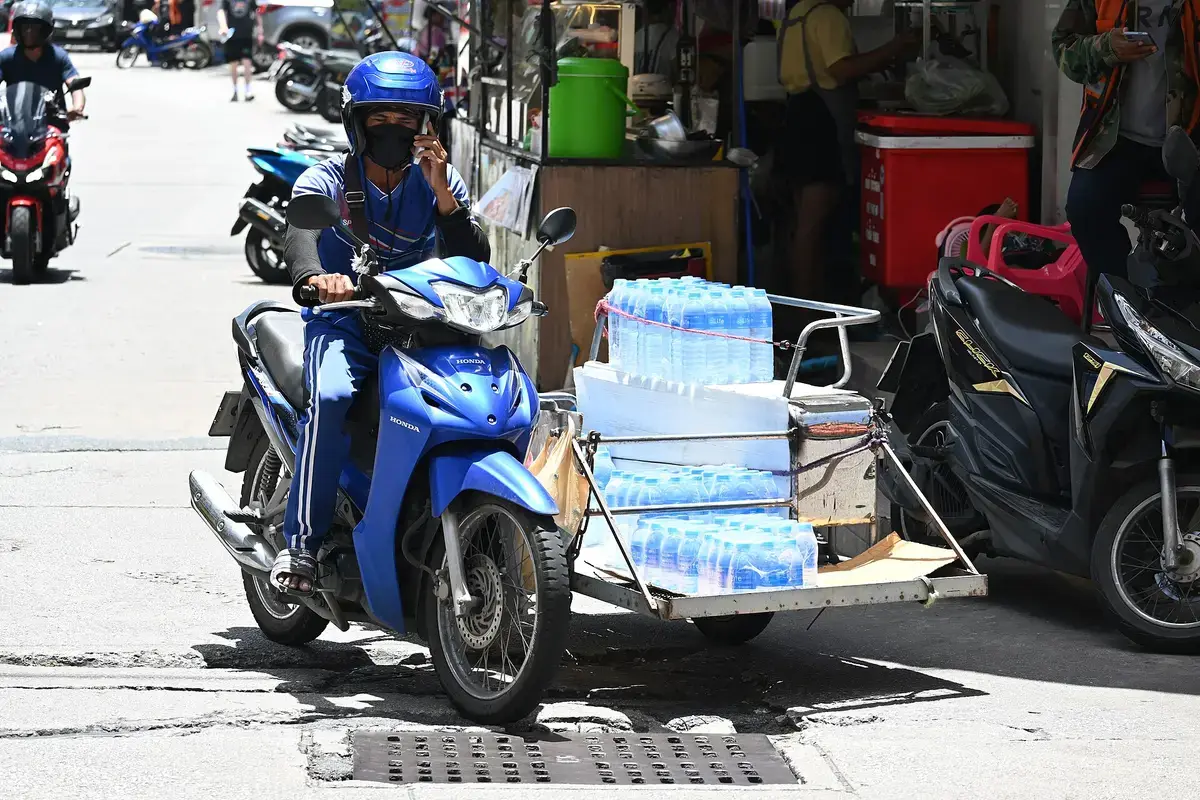
This is the single most expensive gap for anyone travelling in Southeast Asia, where a rented scooter is treated as basic transport rather than an extreme sport. The same document gives a quad bike accident in Greece as an £80,000 example — and then tells you the standard policy does not cover it.
It is not a niche risk on that route either. Our Southeast Asia backpacking route treats short hops by rented scooter as ordinary logistics between towns, which is exactly the habit this exclusion is written around. The countries that come out cheapest in our budget comparison are also the ones where hiring a moped is the normal way to get around — the two facts belong in the same decision.
If you plan to rent a scooter, this is the clause to find in your policy wording before you book anything. Some insurers cover it as a paid add-on, usually conditional on holding the correct licence for that engine size and on wearing a helmet.
2. Adventure sports
The list GOV.UK gives is: “bungee jumping, jet skiing, winter sports or skydiving: these are not usually included in standard policies.”
Note the word usually. Some standard policies do include them, and some exclude them unless you buy an activity pack. The only way to know is to read the exclusions section, not the summary page.
This matters most in places where the activity is cheap and casual. A bungee jump bought on a whim in Nepal is not a mountaineering expedition, but it sits in the same exclusion category as one.
3. Alcohol
“Most travel insurance policies do not cover events that happen after you have drunk excessive alcohol or taken recreational drugs or other substances.”
This is the exclusion people discover after the accident. It rarely appears in a policy summary, and it is applied by insurers when a claim is assessed — so a fall that would have been covered becomes a fall that is not, because of what was in your blood at the time.
The word doing the work is excessive. Policies do not define it identically, and some claims are declined on a reading of the medical report rather than a blood test.
4. Pre-existing conditions
Anything you have been treated for, are waiting to be treated for, or are currently under investigation for has to be declared. GOV.UK’s warning: “failing to declare something may invalidate your travel insurance.”
The trap is the second half of that sentence — currently under investigation. A test you are waiting on when you buy the policy is a pre-existing condition, even if the result turns out to be nothing. Buying insurance the week before you fly, with an unresolved referral in your medical history, is how people end up with a policy that will not pay.
5. High-risk destinations
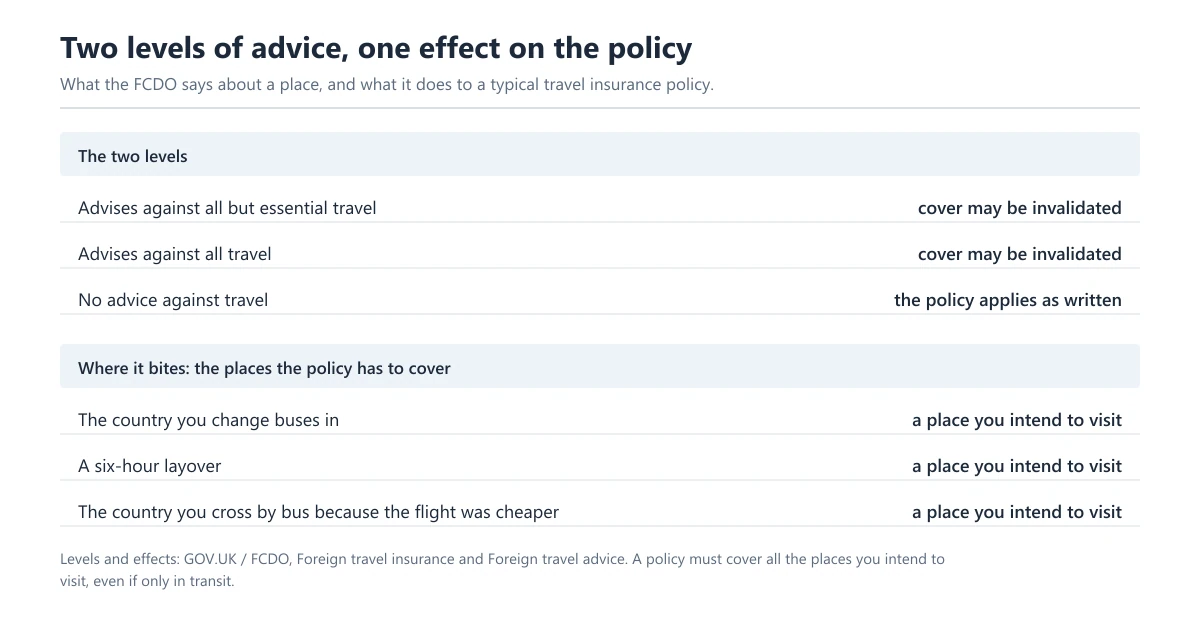
If the Foreign Office advises against all travel, or all but essential travel, to somewhere you are going, “your insurance may be invalidated”.
Backpackers run into this deliberately, usually by crossing a border that is closed or by taking a route that has been advised against. The advice is not a suggestion attached to the policy — it is a condition of it. On a route that crosses several borders it applies to every country along the way, transit included. That rule is worth its own read: see the travel advice that can leave you uninsured.
6. Trip length
Many policies cap how long you can be away — either a maximum trip duration or an annual limit on total days abroad.
A backpacker on a nine-month trip is outside the design of a standard annual policy. What you need is long-stay travel insurance, and the guidance says to “check carefully the maximum duration allowed in any policy you consider buying to ensure that it meets your needs.”
The free health card that is not insurance
If you are a UK resident, you may hold a UK Global Health Insurance Card, or an older EHIC that is still valid until its printed expiry date. It is free, and it is genuinely useful.
The NHS Business Services Authority, which issues it, lists what it covers: emergency treatment, visits to A&E, and routine maternity care — unless the purpose of the trip is to give birth. Outside the UK, it also gives you access to state-provided healthcare on the same terms as a local resident.
What it does not do is more important, and the NHSBSA says it in one sentence: “Your UK EHIC or UK GHIC is not a substitute for travel insurance. It may not cover all health costs and never covers repatriation costs.”
Read the last four words separately. Getting you home in a medical aircraft, or home in a coffin, is the single most expensive thing that can happen to a traveller abroad. The card does not pay for it. GOV.UK adds two more gaps: the card “does not cover any private medical healthcare costs, repatriation or additional costs such as mountain rescue in ski resorts.”
Two useful details from the same source:
- No card with you? A Provisional Replacement Certificate gives you the same level of cover in an emergency. Most travellers do not know this exists.
- Applying is free. The NHSBSA warns specifically about “unofficial websites which may charge you a fee”. There is no fee.
One more, for the optimists: GOV.UK notes that “some insurers may waive any excess on medical treatment if you use an EHIC or GHIC.” Worth asking, worth nothing if you assume it.
How to check your policy in ten minutes
Do this with the policy wording open, not the summary page.
- Search the document for the word “exclude”. That section, not the marketing page, decides what you get.
- Find mopeds by name. Look for “motorcycle”, “moped”, “scooter” and “quad bike”. If they appear under exclusions with no add-on available, decide now whether you will rent one.
- List the activities you actually plan. Bungee, diving, skiing, jet ski. Check each one against the document rather than against what you assume is included.
- Check the alcohol clause. Read how your insurer words it, because the definitions differ.
- Declare every medical condition, including anything under investigation. Get the acceptance in writing before you pay.
- Confirm the trip length in days. Count from the date you leave to the date you land back, not the dates you booked.
- Check the FCDO advice for every country on your route, including ones you only transit. If the advice changes to “all but essential”, get your insurer’s answer in writing before you fly.
- Save the policy number and the 24-hour emergency number offline, and give them to someone at home. If you are unconscious, someone else has to make the call.
- GOV.UK / Foreign, Commonwealth & Development Office, Foreign travel insurance, last updated 2 August 2024 — https://www.gov.uk/guidance/foreign-travel-insurance
- NHS Business Services Authority, Get healthcare cover for travelling abroad — https://www.nhsbsa.nhs.uk/get-healthcare-cover-travelling-abroad
- GOV.UK, Foreign travel advice (for checking a destination before you buy) — https://www.gov.uk/foreign-travel-advice
- Government of Canada, Travel advisories — https://travel.gc.ca/travelling/advisories
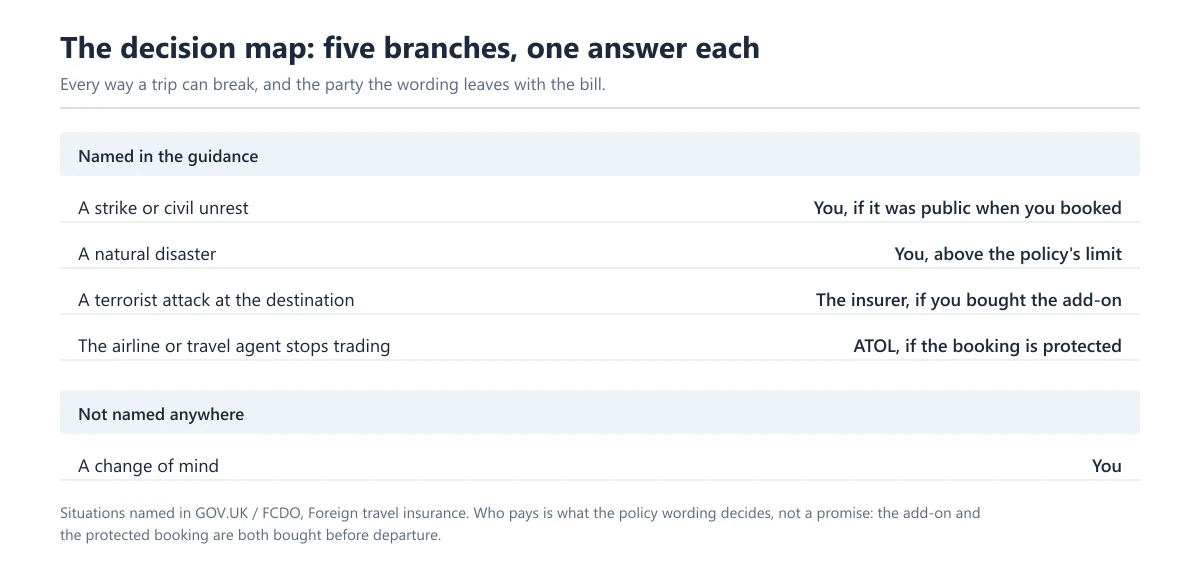
Two clauses worth checking while the document is open: that the insurer runs a 24-hour assistance line, and whether the policy covers airline or travel-agent failure. On the second, GOV.UK’s wording is “typically this is not covered” — for package holidays the protection comes from ATOL, run by the Civil Aviation Authority, not from your insurance.
Conclusion
The pattern across all six exclusions is the same: the policy is built around a holiday, and backpacking is not a holiday. A scooter is transport, a bungee jump is a Tuesday, a nine-month trip is a life. Each of those falls outside the shape the policy was designed for.
None of that is a reason to skip insurance. It is a reason to read eight pages of exclusions before you pay, and to buy a policy that names the things you are actually going to do. GOV.UK’s advice is to buy it as soon as you have booked, not the week before you leave — because the pre-existing condition you are waiting to hear about is only a problem if it is unresolved when you buy.
Start with the exclusion list. If your insurer cannot tell you in writing whether a rented scooter is covered, that is your answer.
About the author
The Shoestring Drift editors. Shoestring Drift is written and maintained by a small editorial team that builds travel guides around published prices and official sources rather than press trips or sponsored stays. Every figure we print carries the date we checked it and a link to where it came from, and we correct articles when a reader tells us a number has gone stale. If a rule in this guide no longer matches what your insurer told you, write to us and we will re-check it.

Related Posts