Backpacking Packing List: What Actually Matters

Last updated: 28 September 2026. Figures checked against the sources listed at the end of this article.
Search for a backpacking packing list and you will find the same advice repeated: take half of what you think you need, roll your clothes, pack layers.
None of that is wrong. It is also not the part that gets people stopped at security, charged at the gate, or separated from their bag for twenty minutes while a tray is re-screened.
The rules that actually change what you pack are narrow, official and frequently out of date on the internet. Some of them changed recently at UK airports, which makes them the clearest illustration of a rule most packing guides still state too confidently.
One of them, on batteries, is the reason a surprising number of people reach the gate without the thing that charges their phone.
The rules that actually change what you pack
Liquids: the limit depends on the airport, not the country
This is the biggest change, and the one most guides get wrong by stating a single number.
The UK government’s current guidance is explicit that the rules depend on the airport. At most UK airports you cannot take liquids in containers larger than 100ml through security — and that applies even if the container is only part full. A 200ml bottle with a teaspoon of shampoo in it is still a 200ml container.
But some airports may allow containers holding up to 2 litres. So the number is not universal, and it is not the same at both ends of your trip. The guidance is to check the rules at the airport you are flying from and at every airport you will pass through, including your return journey.
If your airport asks you to bag your liquids, the specification is precise: a single, transparent, resealable plastic bag holding no more than one litre, measuring roughly 20cm × 20cm, contents fitting comfortably enough that it seals, not tied at the top, and one bag per person.
Liquids are defined more broadly than most people expect. The list includes drinks, liquid or semi-liquid foods such as soup, jam and honey, cosmetics and toiletries including creams, lotions, oils and mascara, sprays including shaving foam and spray deodorant, pastes including toothpaste, gels, and contact lens solution.
Frozen liquids usually cannot go in hand luggage. That includes ice packs. There are limited exceptions, so check the rules for medicines and medical equipment, and for baby food and baby milk, before you fly.
Lighters: one, and it stays on you
If you smoke, this is the rule that catches people. In the UK you can carry one lighter on board. You should put it inside a resealable plastic bag of the type used for liquids, and you must keep it on you for the whole flight. It cannot go in your hold luggage, and it cannot go back into your hand luggage after screening.
Powders and food: not banned, but slow
Powders and food in hand luggage can obstruct the x-ray image. They are not prohibited, but your bag may need to be checked again manually, which costs you time at exactly the moment you do not want to lose it. You can put protein powder, ground coffee or spices in your checked bag to reduce the chance of a delay — that is what the official guidance offers, not something you are required to do.
Batteries and power banks: the rule that costs people their kit
Read this one twice, because the instinct is to do the opposite of what the rules require.
Power banks cannot go in checked baggage. In the UK Civil Aviation Authority’s table of what may be carried, a power bank is listed as “No” for checked baggage and “Yes” for carry-on. Pack it in the bag you check in and it will be taken off you — at best.
The CAA’s restrictions on power banks, in its own terms:
- They must only be carried as carry-on baggage.
- They must not be recharged on board the aircraft, and should not be used to recharge a phone on board either.
- No more than two power banks may be carried per person.
- Units rated up to 100 Wh (lithium ion) or 2 g lithium content (lithium metal) are allowed without operator approval. Between 100 Wh and 160 Wh requires the airline’s approval.
Spare lithium batteries for portable electronic devices follow the same logic: carry-on only. This is a fire-risk rule rather than a paperwork rule, which is why it is enforced at the desk instead of being waved through.
Your airline’s allowance is a separate rule
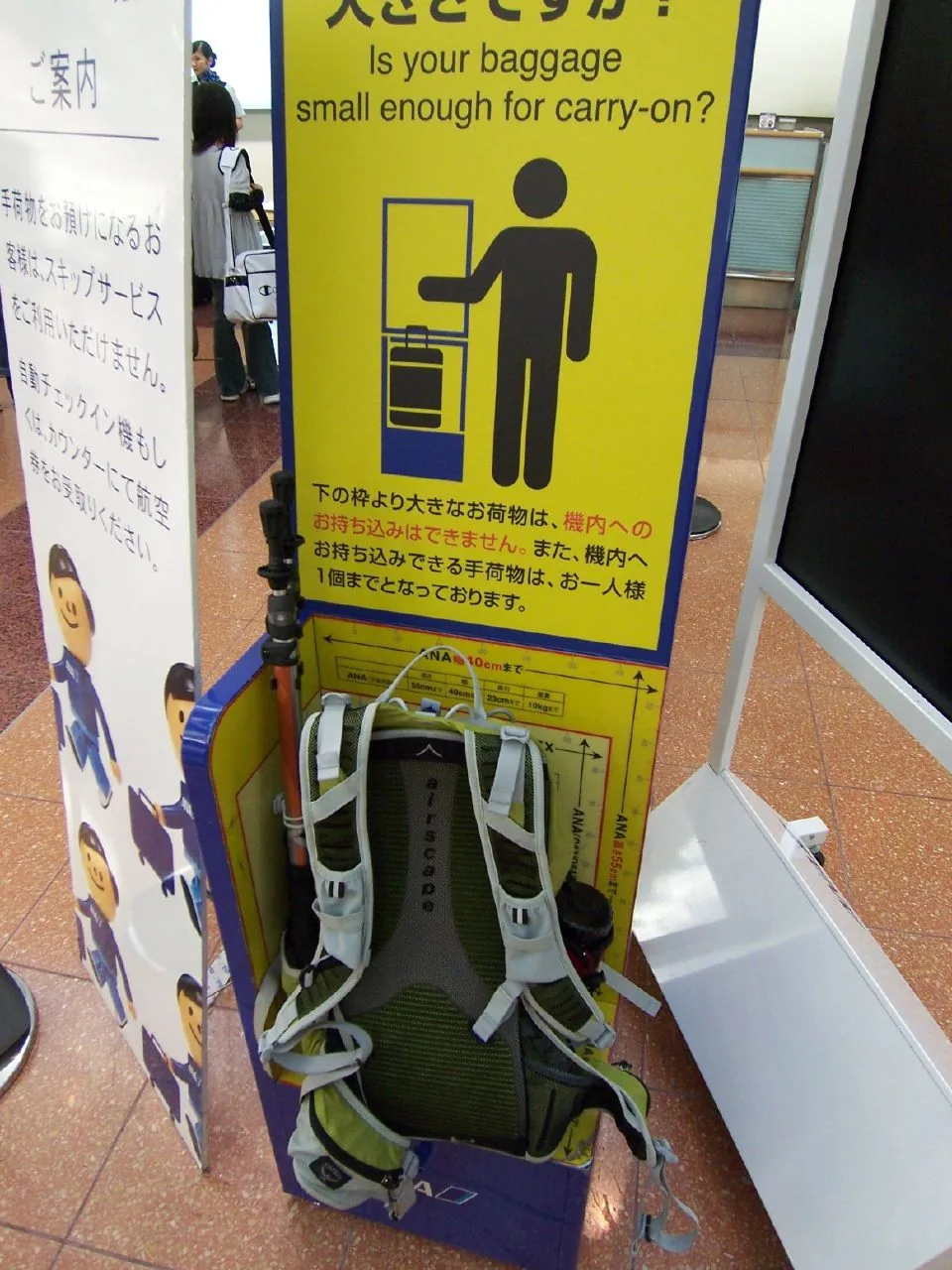
Bag dimensions, weight and how many pieces you may take are set by your airline, not by airport security. The government guidance is simply to check with the airline. Budget carriers enforce this at the gate, and it is the charge most likely to catch a backpacker who packed in a hurry.
What goes in the carry-on and what goes in the hold
The rule of thumb:
Carry-on: documents and cards, medication, one change of clothes, chargers and cables, all batteries and power banks, anything you cannot replace quickly, and whatever you would need to keep going if your checked bag went missing.
Hold: everything liquid over the limit, anything sharp, anything powdery, and your spare shoes. Notice what is missing from that list — batteries. Putting them here is the most common way to lose them.
The mistake is not overpacking the hold bag. It is overpacking the carry-on, because the carry-on is the bag you carry all day and the one that gets weighed at the gate.
The things people carry and never use
Two categories, and both cost you weight.
The “just in case” medical kit
Most backpackers carry a pharmacy they never open. A small kit is sensible: painkillers, rehydration salts, plasters, and any prescription medication with its original packaging and documentation. A comprehensive trauma kit is not. Buy what you need locally when you need it — in most of the destinations where backpackers travel, pharmacies are cheap and everywhere, and this is one of the reasons those countries are cheap.
The second pair of everything
Two pairs of shoes is the correct number: one on your feet, one in the bag. The same logic does not extend to trousers, towels or chargers. Every duplicate item is weight you carry every day to solve a problem that might occur once.
What actually goes in the bag
The rules above tell you what you are allowed to carry. This section is about what to put in. Read it as a shape to adjust rather than a specification: the quantities are conventions that work for most people on a long trip in a warm climate, not measurements anyone took.
Clothing. Three or four t-shirts, two pairs of shorts or trousers, one long-sleeved layer, one light rain shell, five or six pairs of underwear and socks, one pair of shoes on your feet and one in the bag. Clothing is usually the heaviest single category in a long-trip pack, which is why it is the first place to cut.
Toiletries. Everything under 100ml unless you have checked your departure airport, plus an empty refillable bottle you fill after security. Buy the large sizes of anything you use daily when you land — shampoo, sunscreen and insect repellent are cheaper and easier to buy abroad than to carry across a border.
Electronics. One charger with two USB ports instead of three separate chargers, one power bank, one universal adapter, and one cable per device. Cables and adapters add up faster than most people expect, and a good share of what you carry will end up charging something you use once a week.
Documents. Passport, a photocopy kept somewhere else entirely, insurance details, and your vaccination record if your route requires one. Photograph all of it and keep the images offline as well as in the cloud — a phone that has been stolen cannot show border staff a photo stored on it.
The bag itself. For a trip of a month or more, 40 to 50 litres is the usual range. That will pass as carry-on with most full-service airlines and with almost no budget carrier, which is exactly why the airline’s published dimensions matter more than the pack’s reputation.
Frequently asked questions
Can I put a power bank in my checked bag?
No. The UK Civil Aviation Authority lists power banks as “No” for checked baggage and “Yes” for carry-on. They must travel in the cabin, you may carry no more than two per person, they must not be recharged on board, and anything rated above 100 Wh needs the airline’s approval.
Can I take a lighter on a plane?
In the UK, yes — one, inside a resealable plastic bag, kept on your person throughout the flight. Not in hold luggage, and not back into hand luggage after screening. Check the rules for other countries separately.
Is the liquids limit 100ml everywhere?
No, and this is the detail most guides miss. At most UK airports containers cannot exceed 100ml, but some airports allow up to 2 litres. The limit depends on the individual airport, so check your departure airport, your transit airports and your return airport.
Does a partly used container count as a small container?
No. The limit applies to the container’s capacity, not its contents. A 200ml bottle holding 50ml of liquid is still a 200ml container.
Can I take ice packs or frozen food in hand luggage?
Not in the UK. Frozen liquids cannot be carried in hand luggage, with limited exceptions for medicines and baby food.
Why was my bag pulled for a manual check?
Very often powders or food, which obscure the x-ray image. Not a prohibition — just a delay. Moving them to your checked bag removes the problem.
Will my duty free survive a connecting flight?
In the UK you can take liquids bought at an airport or on a plane through security if they are sealed inside a security bag with the receipt sealed in and visible. Do not open the bag until your final destination.
How big a bag can I take?
That is your airline’s rule, not the airport’s. Check the carrier directly, because the allowance varies between them and the gate is an expensive place to discover the difference.
The pre-flight check
Five things decide whether your bag actually gets on the plane. Two of them cannot be answered from memory, which is why this is a job for the week you fly rather than the month you booked.
| Check | What to confirm | Why it matters |
|---|---|---|
| Weigh it | Against your airline’s limit, in the configuration you will carry | The gate is an expensive place to discover the difference |
| Walk twenty minutes with it | Outside, on a pavement — not around your bedroom | Finds the strap, back-panel and weight problems in one go |
| Fit your liquids | Containers inside your departure airport’s limit, in the bag you will really use | The limit depends on the airport, and it has changed recently at some |
| Check the batteries | Every power bank and spare lithium battery in the cabin bag | They cannot travel in the hold at all |
| Read your airline’s dimensions | Weight, size and piece count | This is the airline’s rule, not the airport’s, and it varies by carrier and fare |
Two of those five are moving targets. The liquids limit depends on the specific airport and has changed at several of them; the airline allowance depends on the carrier and on which fare you bought. Confirm both the week you fly, not the day you booked.
Conclusion
Your packing list matters less than three numbers: your airline’s weight and size allowance, your departure airport’s liquids limit, and the number of litres your backpack actually holds when full. Get those right and the rest of the list is preference.
For what those countries cost once you arrive, see our guide to the cheapest countries to travel on a budget, and for how luggage and gear fit into the total, our method for working out what a backpacking trip costs. If you are still deciding where this bag is going, the Southeast Asia backpacking route sequences the countries so you are not carrying it the wrong way round the region. Then pack light, weigh it honestly, and check the rules once more the week you fly — because the airports are the part of this that keeps changing.
About the author
The Shoestring Drift editors. Shoestring Drift is written and maintained by a small editorial team that builds travel guides around published prices and official sources rather than press trips or sponsored stays. Every figure and rule we print carries the date we checked it and a link to where it came from, and we correct articles when a reader tells us something has gone stale. If a rule in this guide no longer matches what you were told at the airport, write to us and we will re-check it.
Sources cited
- GOV.UK, Hand luggage restrictions at UK airports — Liquids, including the transparent bag specification, the 100ml and 2 litre limits and the exemptions — https://www.gov.uk/hand-luggage-restrictions/liquids
- GOV.UK, Hand luggage restrictions at UK airports — Overview, including the one-lighter rule and the food and powders guidance — https://www.gov.uk/hand-luggage-restrictions
- GOV.UK, Hand luggage restrictions at UK airports — Electronic devices and electrical items — https://www.gov.uk/hand-luggage-restrictions/electronic-devices-and-electrical-items
- UK Civil Aviation Authority, Safety advice on what to pack, source for the power bank and lithium battery rules and their exact thresholds — https://www.caa.co.uk/air-passengers/about-your-trip/baggage/safety-advice-on-what-to-pack/
- US Transportation Security Administration, What Can I Bring? — https://www.tsa.gov/travel/security-screening/whatcanibring/all
- Numbeo, Cost of Living country data, September 2026 — https://www.numbeo.com/cost-of-living/

Related Posts