Consular Assistance Abroad: What to Expect When It Counts
Last updated: 28 September 2026. Limits and figures checked against the sources listed at the end of this article.
Your passport is not a promise of rescue.
Every government publishes, in advance and in ordinary language, the list of what it will do for a citizen in trouble abroad and the list of what it will not. The second list is the longer one. The help is discretionary rather than guaranteed, and on a long route the gaps land where a tight budget is likeliest to fail.
What follows is the realistic version: what consular staff actually do on a bad day, where the duty stops, and what the paperwork leaves with you. Our sources are British, and we say so rather than assuming it. If you are in Canada, the United States or Australia, read your own government’s equivalent alongside this one.
How often this actually happens
Whether any of this matters is settled by the numbers. The FCDO’s guidance gives the annual total as “around 20,000 to 25,000 British nationals and their families”, divided into five kinds of case.
| What the FCDO counted in a year | Number |
|---|---|
| Detained or arrested abroad | 5,000 |
| Who need welfare support | 4,000 |
| Who die abroad | 4,000 |
| Who are hospitalised | 3,600 |
| Who are victims of crime | 1,000 |
Two of those lines are the ones you are likeliest to meet: hospitalised, and a victim of crime. Neither requires recklessness. A rented scooter, a night bus, a beach and a bag left on a hostel floor are enough.
The same page adds a figure that is easy to skim past: it issues “approximately 30,000 emergency travel documents to British nationals each year”. That is the document you are handed when the passport is gone; it exists at that volume because losing one abroad is ordinary.
Cost is where most people guess wrong. The help is free and the paperwork is not: “We do not charge for providing consular assistance, but some specific services, such as emergency travel documents, incur fees.” No amount is published for those fees, and nothing here will estimate one. That gap is deliberate. The charter promises only that “We will make it clear if the service you are requesting needs to be paid for, how much this is and how you can pay.” The counts carry no year either, on a page published on 31 August 2022.
What is promised, and what is refused
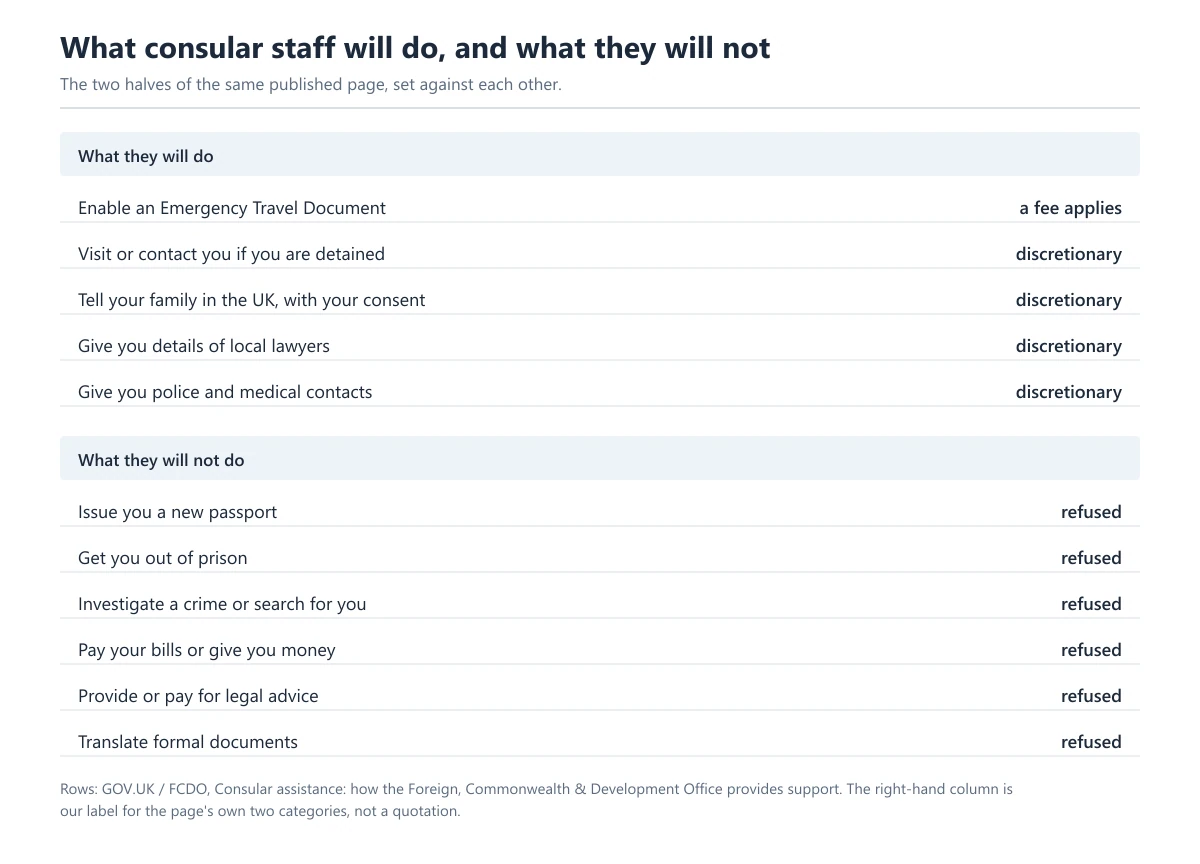
Duties and refusals sit on the same page, in two adjacent sections — How we can help and What we cannot do — which makes them easy to set against each other. The table below pairs them by situation, because that is how you meet them.
| When this happens | What they will do | What they will not do |
|---|---|---|
| Your passport is lost or stolen | Get you “an Emergency Travel Document”; “There is a fee for this service” | “accept passport applications or issue new passports” |
| You are arrested or detained | “visiting or contacting you if you are arrested or detained”, and telling your family “with your consent” | “get you out of prison, prevent the local authorities from deporting you after your prison sentence, or interfere in criminal or civil court proceedings” |
| You are the victim of a crime | “providing contact information for local police and medical services” | “investigate crimes or carry out physical searches for missing people” |
| You need a lawyer | “We cannot provide legal advice but can give you details of local lawyers” | “provide you with legal advice or pay for these services for you” |
| You need a document translated | Details for local interpreters | “translate formal documents, provide formal interpreting services or pay for these services” |
| You have run out of money | “we may be able to direct you to others who may be able to help” | “pay your bills or give you money” |
Read the two facing columns together and a shape appears, though this is our reading rather than the page’s own wording: what a consular service supplies is information, presence and pressure applied to local authorities, and what it withholds is money, outcomes and legal force. Every refusal is a version of the same sentence. Another country’s law, another country’s police and another country’s courts decide what happens next, and a foreign official standing in the room changes none of it. Nor is the middle column a promise of a result: it sits under the sentence “The provision of consular assistance is at our discretion”.
The list above is British: it comes from the UK’s Foreign, Commonwealth & Development Office, and so are the fees. Outside the UK, find your own government’s version before you need it. We link to the starting points — Canada, the United States and Australia — rather than summarising them: we did not read those pages for this article.
The sentence that governs the whole list
One line decides how everything above should be read, and it sits under the heading “What we cannot do”: “You do not have a legal right to consular assistance, and you should not assume assistance will be provided.”
A right is something you can demand; this is a service you ask for. The page says the help “depends on the situation and the person’s circumstances”, and that priority goes to those it assesses as vulnerable: “We generally consider someone vulnerable when they cannot protect themselves from significant physical or emotional harm, or be protected by others.” The collection page puts the same order first: help on “how you can help yourself stay safe abroad” comes before the office’s own support.
The refusals have a legal footing. The United Kingdom is a party to the Vienna Convention on Consular Relations, and the page states the consequence plainly: “The treaty states that our staff must not interfere in the internal affairs of the host country when providing consular assistance.” A consulate that cannot interfere can still inform, witness and ask, and the asking is what puts a case in front of those who hold the power. Two more sentences matter, both easy to skim past: “The relevant authorities in the country or territory you are in are responsible for your safety and security”, and “Local authorities abroad will not treat you differently because you are British.”
When the list gets shorter
The situations in which the help shrinks are short and specific. The FCDO names five: being in a place where it has advised against all travel; being in a country where it has no diplomatic or consular presence; a case where helping you could put others or staff at risk; abuse directed at staff; and being a dual national in the country of your other nationality.
A consulate is a building, and some places do not have one.
The staff limit is written down twice, both times as a refusal rather than an apology. The charter says: “We have a duty of care to our employees and we will not send our staff into a situation where we judge that their safety could be seriously at risk.” On behaviour it is blunter: “The FCDO has zero tolerance of damage to property or abusive, racist, vexatious and threatening behaviour towards our staff.”
The advice you were given before you left carries a price when you ignore it: the charter warns that “If you travel against our advice, it may limit the assistance we can provide to you.” That sentence joins two subjects this site normally treats apart, and our guide to the advice levels that can leave a policy uninsured covers the other half. The last limitation says where the money question goes: the list of referrals ends with “your travel insurer or provider”. Consular staff are not a substitute for a policy, and what a policy pays for is decided by its exclusions, which our guide to what a backpacker policy usually leaves out sets out.
What you are asked to arrange instead
Everything the FCDO publishes on this subject ends with a list of things to do before you fly, and the emphasis never moves: the state handles the emergency, you handle the preparation.
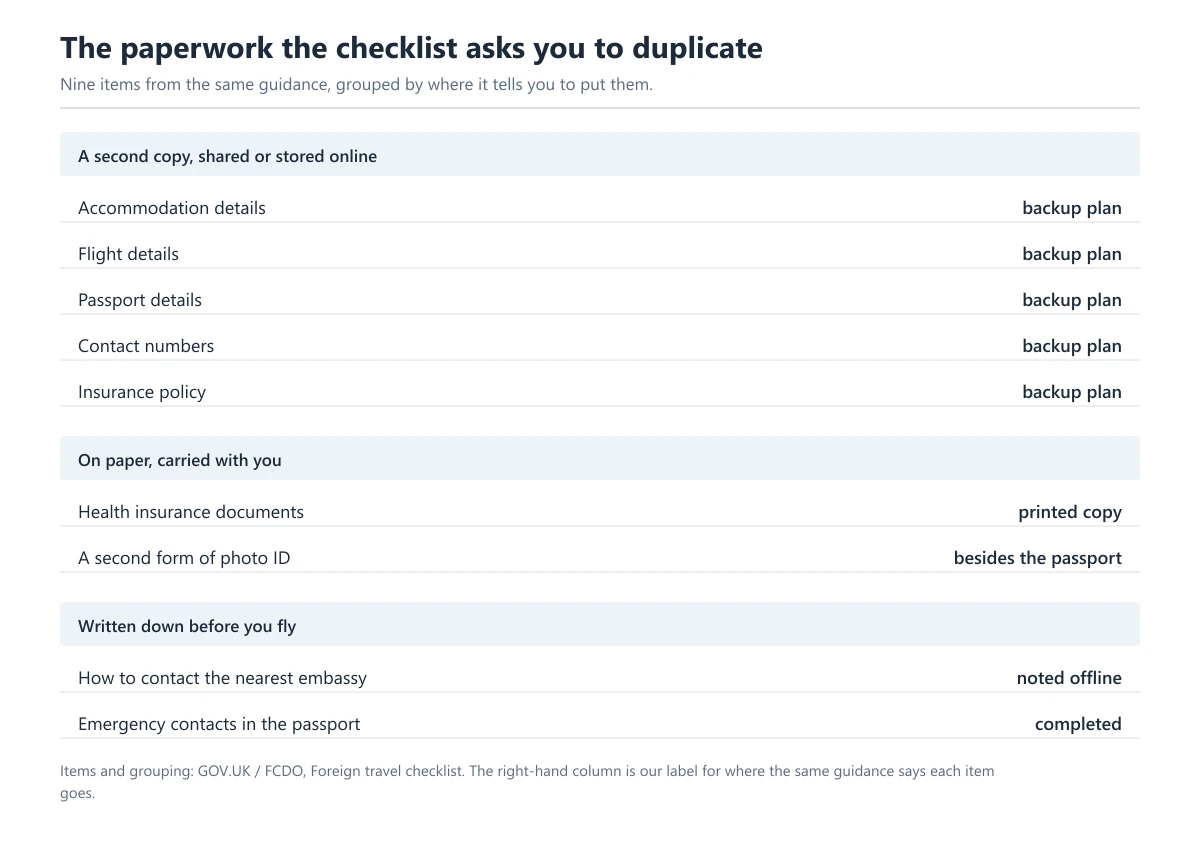
It begins with insurance bought “as soon as you book”, a passport that meets the entry requirements of the country being visited, the correct visa, and “an extra form of photo ID with you, other than your passport”. Then vaccinations and health precautions, sorted at least eight weeks ahead — the one deadline in the document measured in months rather than days — and accommodation that meets basic health and safety standards. That last item belongs in the same decision as the nightly price, and our guide to the checks worth making before you book a bed treats it that way.
The section written for when a phone disappears matters most. It asks for “a backup plan for accessing key information such as your accommodation details, flight details, passport details, contact numbers and insurance policy”, shared with someone at home or stored online, and adds an instruction easy to skip: the health insurance documents printed and carried, not left in an inbox.
Two items matter more on a long trip than they look, and the first is the one a tight budget argues with: the checklist’s instruction that “you can access enough money to pay for unexpected costs or if your main payment method fails”. Our method for building a trip budget already treats a cushion as a line of its own. The second is the note of “how to contact the nearest British embassy, high commission, or consulate”, written down before you need it — like the emergency contacts page the passport asks you to complete. The last word goes to the FCDO’s own disclaimer: “No foreign travel can be guaranteed as safe, and you take personal responsibility for your own travel.”
Conclusion
Consular assistance is real, and the counts show how often it is used: tens of thousands of cases a year, most of them unremarkable. What it is not is a promise. It is discretionary, it is bounded by another country’s law, and the parts of a bad week that cost the most — the hospital bill, the flight home, the lawyer — sit outside it.
So plan for a division of labour: your government can be present, can inform and can press where pressing helps. Everything with a price attached is yours to arrange. One action today takes ten minutes: open your own government’s consular assistance page, read the list of things it will not do, and check your policy against that list.
About the author
The Shoestring Drift editors. Shoestring Drift is a data-driven publication: the guides are built from published prices and official documents rather than press trips or sponsored stays. Every rule carries the date we checked it and a link to its source, and we re-check anything a reader tells us has gone stale. If a rule here no longer matches what your government publishes, write to us and we will look again.
Sources cited
- GOV.UK / Foreign, Commonwealth & Development Office, Support for British nationals abroad, the collection page — https://www.gov.uk/government/collections/support-for-british-nationals-abroad
- GOV.UK / FCDO, Consular assistance, source of the case counts, the fees sentence and the refusal list — https://www.gov.uk/guidance/consular-assistance-how-the-foreign-commonwealth-development-office-provides-support
- GOV.UK / FCDO, Consular Charter, source of the duty-of-care and travel-against-advice sentences — https://www.gov.uk/government/publications/consular-charter-for-services-to-british-nationals-abroad/consular-charter
- GOV.UK / FCDO, Foreign travel checklist, updated 5 June 2026 — https://www.gov.uk/guidance/foreign-travel-checklist
- Government of Canada, Travel advisories — https://travel.gc.ca/travelling/advisories
- US Department of State, International Travel — https://travel.state.gov/content/travel/en/international-travel.html
- Australian Government, Smartraveller — https://www.smartraveller.gov.au/

Related Posts