Vaccinations for Backpacking Southeast Asia: When to Start
Last updated: 28 September 2026. Every quoted line was copied from the page named beside it and checked against the original.
Which vaccinations do I need? Four government health pages cover Thailand, Vietnam, Cambodia and Laos, and all four answer that question the same way: they send you to two other websites.
That is not evasion. They state their own limit in one sentence, and most readers never reach it: “The FCDO cannot provide tailored advice for individual trips.”
So this article does what those pages will not. It sets out what they say about vaccines and malaria, separates what they leave to a clinician from what they never cover, and turns their shared instruction — “At least 8 weeks before your trip” — into a countdown.
What the four health pages actually contain
The two checks all four pages open with
All four open with the same two checks, in the same words: “Before you travel check that:”, then “your destination can provide the healthcare you may need” and “you have appropriate travel insurance for local treatment or unexpected medical evacuation”.
A third line follows, identical on all four, and it decides whether the rest applies: “This is particularly important if you have a health condition or are pregnant.”
After that they diverge, because the four countries are not in the same situation.
The numbers each page prints
Thailand prints two emergency numbers, “Dial 191 and ask for an ambulance”, with 1669 as the local alternative. Vietnam prints one, 115. Cambodia prints one, 119.
Laos prints one, 1195, plus two voluntary services and a warning about who turns up: “There have been reports of bogus companies attending accidents and trying to charge fees.”
Then each page lists the diseases it wants you to know about.
| Country | Health risks its own page names | What the page says about care there |
|---|---|---|
| Thailand | Zika virus; malaria and dengue; rabies; altitude sickness | “All hospitals require a guarantee of payment before treating patients.” |
| Vietnam | mosquito-borne diseases such as Zika virus, dengue, malaria and Japanese encephalitis; air pollution; altitude sickness | “The British Embassy do not pay medical bills and cannot provide medical assistance.” |
| Cambodia | malaria and dengue; Zika virus; schistosomiasis; biting insects and ticks | FCDO publishes a list of medical providers where some staff speak English |
| Laos | dengue and malaria; anthrax; air pollution | “Medical care in Laos can be basic and outside the capital there are no reliable facilities to deal with medical emergencies.” |
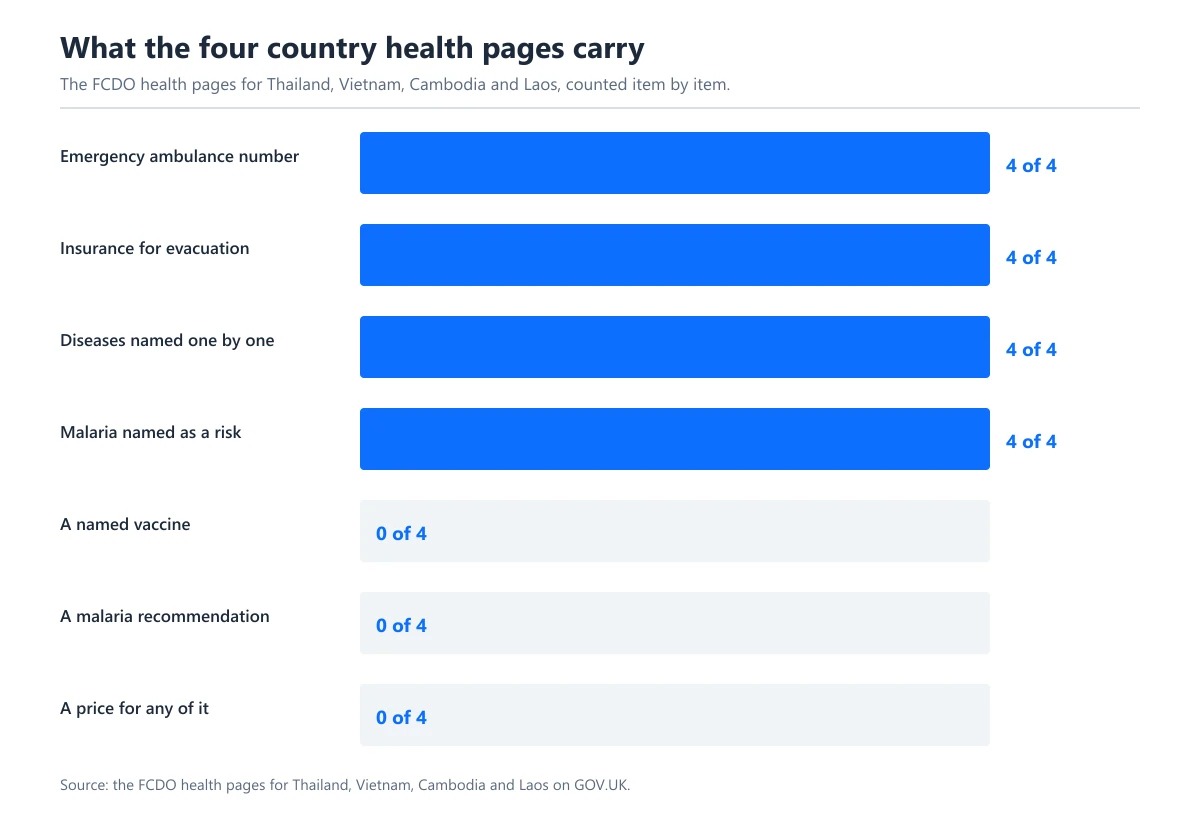
Malaria is on all four of those lists, and so is dengue. A recommendation about either is on none of them. Read those two sentences twice.
The pages say which diseases are present and how a country’s health system behaves. They say nothing about what should go into your own body, because that answer depends on facts no country page has been told.
The second opening bullet is the one with money behind it. Local treatment is what a policy pays for when a clinic wants paying first, and evacuation is the flight home nobody budgets for.
Our guide to the exclusions in a standard backpacker policy covers the activity half, and the advice levels that can invalidate a policy outright cover the rest.
What the pages leave to a clinician
The three times the word appears
The stem vaccin appears three times on each of the four pages, and never in front of the name of a vaccine.
Once in the heading over the section, “Vaccine recommendations and health risks”. Once in the instruction to look the country up elsewhere: Thailand’s bullet reads “check the latest information on vaccinations and health risks in TravelHealthPro’s Thailand guide”.
Vietnam’s reads “the latest vaccine recommendations for Vietnam in TravelHealthPro’s Vietnam guide”, under a line that supplies the missing verb, “At least 8 weeks before your trip check:”.
And once in the line about paying for one, identical on all four: “see where to get vaccines and whether you have to pay on the NHS travel vaccinations page”.
That is the whole of it. No page names a product, a course, a dose, or a price.
What the four pages say about malaria
Malaria gets the same treatment. Thailand and Cambodia list “malaria and dengue” as one item; Vietnam files “malaria and Japanese encephalitis” inside a list of mosquito-borne diseases.
Laos is the only one of the four that attaches an action to the word, and the action is bite avoidance, not medicine: “Dengue and malaria are endemic, so you should increase precautions to avoid being bitten by mosquitoes”.
Neither the word antimalarial nor the word prophylaxis appears anywhere on the four pages.
This is not an oversight, and GOV.UK’s own description says so: “We link extensively to TravelHealthPro as the experts on health risks overseas.” and “The NHS provides general information on travel vaccinations.”
What WHO adds
Above the national pages sits a second layer: WHO’s travel advice page describes itself as providing “information about infectious disease risks and vaccination requirements”, and publishes the country lists behind the certificate questions.
One of those lists deals with the certificate a border can ask for, and its description reads “This list includes only countries or areas where WHO has determined there is a risk of yellow fever transmission and/or where there are country requirements”.
The words yellow fever appear nowhere on the four FCDO health pages, so on a route that touches a zone where a border can ask for a certificate, the country page is not where the question lives.
Bring the route, not the country
Four pages describe four countries; none of them knows that you are spending nine days in the north, crossing two land borders and finishing on an island. You are the only one there who has seen the whole map.
The list worth carrying in is the route in order with dates, the length of the trip, anything you take every day, and the two things the pages single out — a health condition, or pregnancy.
One more item belongs in the folder, and it is a legal rule rather than a medical one. Vietnam’s page states that “It is illegal to have more than 7 days of prescribed medicine by a doctor (addictive and psychotropic medicine).” Carrying more needs a letter from a doctor, and the page sets out what it must show: your name and age, “the medicine name, volume and dosage”, and the doctor’s signature and address. A letter is a document, which means it has a lead time and a signature attached, and neither of those can be arranged in the week you fly.
The countdown: six weeks, four weeks, two weeks, one week
One instruction on those pages carries a number, and it is the same on all four: “At least 8 weeks before your trip”. GOV.UK puts the same marker in its travel checklist, in a line that tells you to check “what vaccinations you need and what health precautions you should take”, and to do that check at least eight weeks ahead.
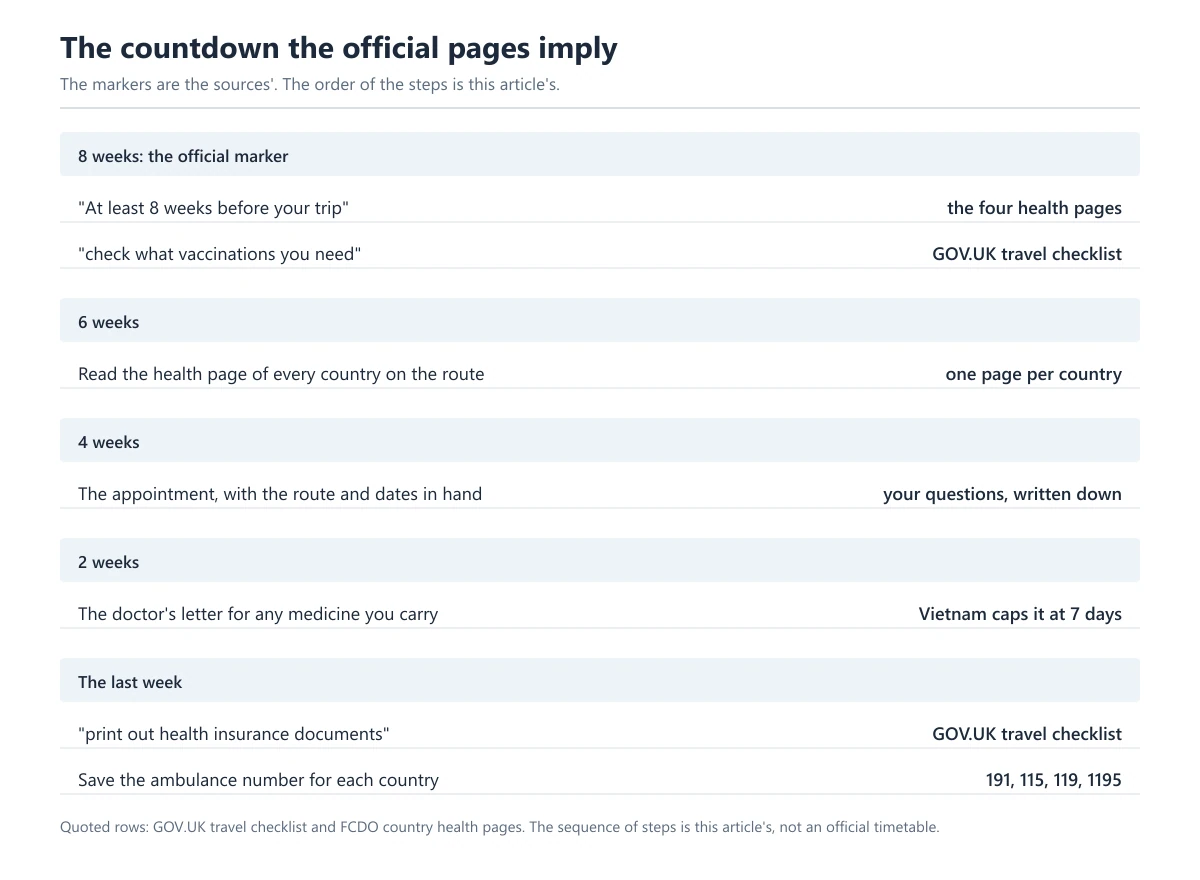
The sequence under that marker runs backwards from the flight. The order is ours, not an official timetable; the quoted markers are not.
| When | What should be done by then | Where that comes from |
|---|---|---|
| 8 weeks | check what vaccinations you need, and what health precautions to take | the GOV.UK travel checklist |
| 6 weeks | read the health page of every country on the route | the four FCDO health pages |
| 4 weeks | the appointment, with the route and the dates in hand | our sequence |
| 2 weeks | the doctor’s letter for any medicine you carry | Vietnam’s medicine rules |
| the last week | insurance documents printed, ambulance numbers saved | the GOV.UK travel checklist |
Six weeks out
At six weeks you are two weeks past the marker the pages print, which sounds worse than it is. Nothing on them says what happens at eight weeks; the number is there because appointments and signatures take time.
What six weeks buys is reading time. Every country on the route has its own page, so a route crossing three borders needs four read in travel order. Write the risks down as you go: those notes go to the appointment.
Four weeks out
Book the appointment here, not in the final week, and take the notes with you. The pages say where the practical half is answered: the line quoted above about the NHS travel vaccinations page, which is also the clearest proof they were written for one country’s readers.
Insurance belongs in this window too: “get appropriate travel insurance as soon as you book. Check that it covers the places you will visit, the duration of your visit and any planned activities such as adventure sports”.
A nine-week route does not fit a fourteen-day policy, which is the number our guide to what backpacking actually costs wants written down first.
Two weeks out
This is the paperwork week. All four pages carry the same warning about the medicine you already take: “The legal status and regulation of some medicines prescribed or bought in the UK can be different in other countries.” Vietnam’s seven-day rule is the most concrete version, and the one that needs a signature.
Thailand adds a line worth reading twice: “Medication sold on the street may not be genuine or may have been stolen.”
The last week
What is left is documents and numbers. The checklist’s last health item is a printing job: “print out health insurance documents”, and carry a copy with you.
Two of the country pages explain why the paper matters, and neither means the flight home. Thailand states that “All hospitals require a guarantee of payment before treating patients.” Laos says that “You may be asked to pay for an ambulance and any treatment you need in advance.”
Save the numbers somewhere that does not need a signal: 191 in Thailand, 115 in Vietnam, 119 in Cambodia, 1195 in Laos.
Laos comes with a condition attached, written on its own page: “Make sure anyone attending an accident is wearing a uniform marked ‘Vientiane Rescue’ or ‘Lao Red Cross’.”
Who these pages are written for
Everything quoted so far is the British version, published by the Foreign, Commonwealth & Development Office, and it was written for people leaving the UK. If that is not you, keep reading.
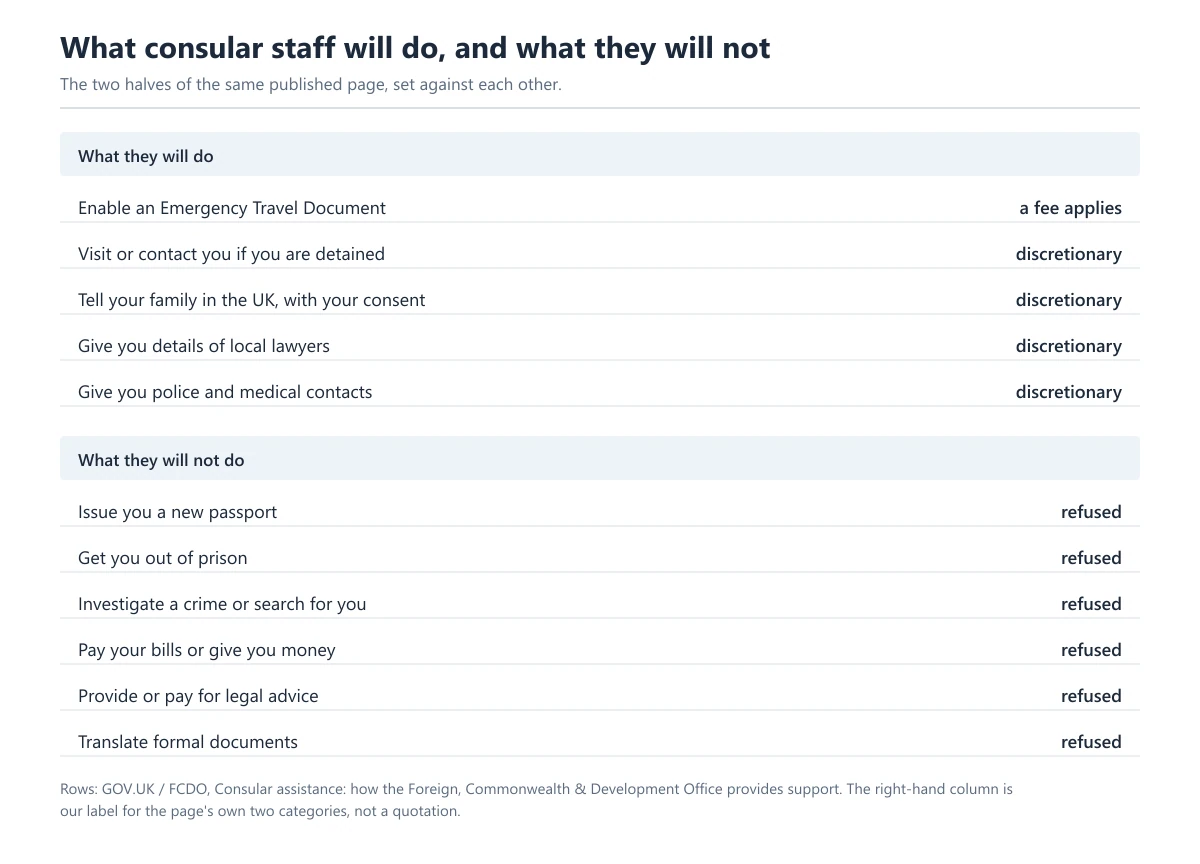
Every page points at the NHS. Vietnam’s page states that “The British Embassy do not pay medical bills and cannot provide medical assistance.”
The rest is written down, though not on the health pages. GOV.UK’s description of the service says that it provides “information on the most common entry requirements for people travelling on a full ‘British citizen’ passport from the UK”.
The disclaimer closing that same page describes the advice as “for the convenience of British nationals, as a general guide only”.
If you are not leaving from the UK
If you are in the United States, Canada or Australia, open your own government’s version first and treat the British pages as a second opinion: the CDC’s travel health pages, the travel advisories published by the Government of Canada, and Smartraveller in Australia.
What changes with your passport is the service half: who pays, who is sent to help, and where an appointment happens. Malaria is named on all four of the British pages, and it does not ask for a passport. So the answer to the question at the top of this article is not a list of vaccines. It is one page read per country, one appointment booked early, the route written on paper, and a policy that covers the whole trip.
Conclusion
No official page will tell you which vaccine to get. That is not a gap in the advice; it is the advice. The four pages name the diseases and describe the standard of care, and then hand the decision to someone who can see you and not just the country. What they give you instead is the deadline: “At least 8 weeks before your trip”.
Work backwards from the flight, not forwards from today. Six weeks is enough to read four pages, four weeks for an appointment and a policy, two weeks for a letter to be signed, and the last week for a printer and a list of ambulance numbers. Do that and the trip gets to be about the trip.
Our route through the four countries is the next thing worth reading, and the packing list is where the folder with the letter belongs.
About the author
The Shoestring Drift editors. This article was researched and written by the Shoestring Drift editorial team, which builds its guides from government publications and published data rather than from journeys it has taken. Every line in quotation marks above was copied from the page named beside it and compared against the downloaded original. If a rule here no longer matches your own government’s advice, write to us and we will read the source again.
Sources cited
- Foreign, Commonwealth & Development Office, Thailand travel advice: Health — https://www.gov.uk/foreign-travel-advice/thailand/health
- Foreign, Commonwealth & Development Office, Vietnam travel advice: Health — https://www.gov.uk/foreign-travel-advice/vietnam/health
- Foreign, Commonwealth & Development Office, Cambodia travel advice: Health — https://www.gov.uk/foreign-travel-advice/cambodia/health
- Foreign, Commonwealth & Development Office, Laos travel advice: Health — https://www.gov.uk/foreign-travel-advice/laos/health
- World Health Organization, Travel advice — https://www.who.int/travel-advice
- GOV.UK, About Foreign, Commonwealth & Development Office travel advice, source of the sentences on who the service is written for — https://www.gov.uk/guidance/about-foreign-commonwealth-development-office-travel-advice
- GOV.UK, Foreign travel checklist, source of the eight-week line, the insurance timing and the printing instruction — https://www.gov.uk/guidance/foreign-travel-checklist
- Centers for Disease Control and Prevention, Travelers’ Health, named as the United States equivalent and not read for this article — https://wwwnc.cdc.gov/travel
- Government of Canada, Travel advisories, read as the Canadian equivalent — https://travel.gc.ca/travelling/advisories
- Smartraveller, Australian Government, named as the Australian equivalent and not read for this article — https://www.smartraveller.gov.au/

Related Posts