How Much Does It Cost to Backpack? A Real Method
Last updated: 28 September 2026. Figures checked against the sources listed at the end of this article.
Two people travel the same route for the same four weeks. One spends roughly three times what the other does, and neither is being reckless. The difference is almost never food, and it is rarely the countries they chose. It is that one of them costed the trip and the other estimated it.
Estimating produces a number that feels plausible and collapses on contact with a real month of travel. Costing produces a number you can defend before you book anything. The gap between the two is this article. Below is a six-line method, worked through with real prices, plus the costs that most budgets forget until they appear on a card statement — starting with the one that is usually the biggest of all.
Why a daily budget is the wrong unit
Search for “backpacking costs” and you will be handed a daily figure: $30 a day, $50 a day, $15 a day. These numbers are not wrong so much as useless, for two reasons.
A daily figure hides its own assumptions. The person quoting $30 a day has silently decided where you sleep and how often you move. Change either and the number is meaningless, with no indication of which assumption you broke.
Fixed costs do not divide neatly. A visa fee, an insurance policy and a flight are not daily expenses. Spread them across a forty-day trip and they look small; pay them in one week and they dominate your cash flow.
The method below builds the number from six lines instead. It takes about twenty minutes, and it does not fall apart the first time a bus is cancelled.
The six lines every backpacking budget has
Every backpacking trip is made of these:
- The long-haul flight — the return ticket that gets you to the region in the first place.
- Fixed entry costs — visas, entry or exit fees, permits, vaccinations. Paid once per country, regardless of how long you stay.
- Transport between places — flights, trains, buses and ferries inside the region. A lump sum for the route, not a daily rate.
- Accommodation — your nightly rate multiplied by your nights. Usually the largest line once you are actually there.
- Daytime costs — food, water, local transport, entry tickets, the small stuff.
- Buffer — the percentage you add because the plan will change.
- Compare your total against your savings, not against a forum post. If the number requires you to earn while travelling, the plan is a different plan.
- Stress-test the accommodation line. Recalculate with it 30% higher. If that breaks the trip, your margin is too thin for a long journey.
- Count your border crossings. Each one costs money and a day. If your route has many and your budget has few days, fix the route, not the budget.
- Keep a real record for the first two weeks. After fourteen days you will know your true daily burn, and it is usually higher than the estimate. Adjust then, while you still have money and options.
- UN Tourism, International tourist arrivals up 4% in 2025 reflecting strong travel demand around the world, 20 January 2026 — https://www.untourism.int/news/international-tourist-arrivals-up-4-in-2025-reflecting-strong-travel-demand-around-the-world
- Numbeo, Cost of Living country data for Thailand and Vietnam, September 2026 — https://www.numbeo.com/cost-of-living/
- exchangerate-api.com, exchange rates dated 27 September 2026 — https://www.exchangerate-api.com
- UK Foreign, Commonwealth & Development Office, Foreign travel advice — https://www.gov.uk/foreign-travel-advice
The flight is the line most budget breakdowns leave out, and on a short trip it is usually the biggest number of all. The same ticket behaves completely differently depending on how long you stay: a $900 return fare spread over two weeks is $64 a day; the same fare spread over six months is under $5 a day. That is why “how much does backpacking cost” has no single answer — and the flight is the clearest proof of it.
Lines 1, 2 and 3 scale with your route. Lines 4 and 5 scale with your time. The distinction is the whole method: a long trip in one place is cheap, a short trip across many borders is not, and both can show the same daily spend figure while costing wildly different amounts overall.
Building the number, step by step
Step 1 — Set your daytime costs from real prices
Use current local prices rather than a vibe. Numbeo’s country data for September 2026 puts a cheap restaurant meal in Thailand at about $3.00, bottled water at about $0.35, a local bus or metro hop at about $0.90 and a domestic draft beer at about $2.10 (converted at rates dated 27 September 2026).
Add those up the way a day actually works — three meals, four local journeys, a couple of bottles of water and a beer — and Thailand lands at $15.40 a day. Vietnam, on the same pattern, lands at $8.65. That gap is the whole argument for choosing your country carefully. Every figure below is built from these rounded prices, so the sums can be checked against the numbers on this page.
Step 2 — Set accommodation separately, at your own rate
This is the line you must research yourself, because it is the one that swings the total most and the one no country average can answer. Look up actual nightly rates for your destination and season, not the cheapest rate you can find in a low-season search.
For the worked example, assume $15 a night in Thailand. Mark it clearly as an assumption — the arithmetic below is only as good as this number, and yours will differ.
Step 3 — Add transport as a lump sum for the route
Count your country-to-country moves and price them individually, including the transfer at each end. Every border crossing realistically consumes a day, so this line costs you money and it removes days from the rest of your trip.
Step 4 — Add the fixed entry costs
Total the visa and entry fees for every country on the route, plus insurance for the full period. These do not shrink if you travel slowly, which is why slow travel is cheaper per day but not per country.
Step 5 — Add a buffer, then divide
Add 15-20%. This is not padding for luxuries; it covers the missed connection, the extra night, the thing that broke. Then divide by your number of days to get a daily figure you can actually defend.
The worked example, assembled
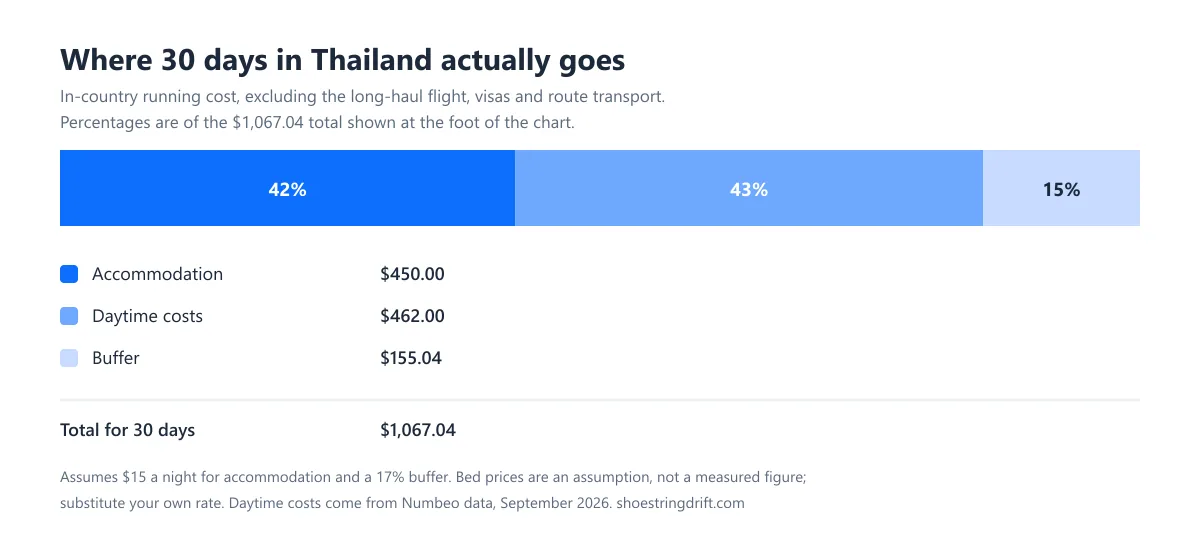
Thirty days in Thailand, at the assumptions stated above. The table covers only the in-country running costs — lines 4, 5 and 6. Flights, visas, insurance and route transport are yours to fill in, and they are added afterwards.
| Line | Calculation | Total |
|---|---|---|
| 4. Accommodation | $15 × 30 nights | $450.00 |
| 5. Daytime costs | $15.40 × 30 days | $462.00 |
| Running subtotal | — | $912.00 |
| 6. Buffer at 17% | $912.00 × 0.17 | $155.04 |
| In-country running cost, 30 days | $1,067.04 | |
| Daily equivalent | $1,067.04 ÷ 30 | $35.57 |
Three things to notice, and the third is the one that trips people up.
First, accommodation is just under half the running subtotal — 49% — which is why choosing where you sleep matters more than choosing where you eat. Measured against the total of $1,067.04 rather than the subtotal, the same line is 42%, and the breakdown chart below uses that base: 42% accommodation, 43% daytime costs, 15% buffer. Both figures are right; they answer different questions.
Second, the daily equivalent of $35.57 is about 2.3 times the $15.40 daytime figure. Anyone quoting the daytime number as a daily budget is quoting less than half of even the in-country cost.
Third, this is not the cost of the trip. $1,067.04 buys you thirty days in Thailand once you are there. It does not include getting there. Add your return fare, your visas, your insurance and your internal transport, and the real total moves — and on a trip this length, the flight alone can add more than the whole running cost. That is why the daily figure above should be treated as a floor, not an answer.
To finish the sum: take the running cost, add lines 1, 2 and 3, and then decide whether your buffer needs to cover those too. A buffer of 17% on the running cost is sensible; a buffer of 17% on a non-refundable flight you have already paid for is not a buffer at all.
Swap Thailand for Vietnam, keep the same structure, and both the daytime line and the accommodation line fall — which is exactly why the country choice compounds rather than merely adding up.
The costs people forget
Visa run costs. If your route requires leaving and re-entering a country, the exit, the re-entry and the transport between them are all real costs that appear on no daily budget.
Airport transfers. The bus from an airport into a city is often several times the price of a local bus, and there is one at each end of every flight.
The first and last days. Arrival days are expensive: SIM card, a night you overpay for because you are tired, food at whatever is open. Budget one full extra day’s cost at each end.
Insurance that does not cover what you are doing. Paying for a policy is not the same as being covered. Check that it covers the activities you actually plan, and the countries on your route — our guide to travel insurance for backpackers lists the six exclusions that catch people travelling this way.
The cost of changing your mind. Every unplanned move is a ticket bought at short notice. This is what the buffer is for.
Cash withdrawal and card fees. Small per transaction, significant over a long trip, and completely invisible in a daily figure.

How to check the number is realistic before you book
Conclusion
The number you want is not a daily rate someone else published. It is six lines — the long-haul flight, fixed entry costs, route transport, accommodation, daytime costs and a buffer — assembled from prices you checked yourself and dated. Build it once and you can re-run it for any country in about ten minutes.
For the price inputs, start with our comparison of the cheapest countries to travel on a budget, and for the accommodation line — the one that decides whether the total holds — see how to choose a hostel without paying for a location you did not need. Then write the number down before you book, so that the trip you take is the trip you costed.
About the author
The Shoestring Drift editors. Shoestring Drift is written and maintained by a small editorial team that builds travel guides around published prices and official sources rather than press trips or sponsored stays. Every cost figure we print carries the date we checked it and a link to where it came from, and we correct articles when a reader tells us a number has gone stale. If a price in this guide no longer matches what you paid, write to us and we will re-check it.

Leave a Reply